The Science of Afghani Kabuli Pulao: Gelatinisation, Maillard Accents, and Lipid Infusions
Kabuli Pulao, the crowning achievement of Afghan cuisine, is a masterclass in balancing structural rice chemistry with complex thermodynamic sweet-to-savoury transitions.
Unlike other regional pulao that rely on delicate spice profiles, an authentic Kabuli pulao leverages a robust, rich meat broth paired with deeply caramelised vegetable toppings.
The ultimate goal of this culinary system is to yield elongated, individual grains of rice that are deeply savoury on the inside, yet glossy and separated on the outside.
1. The Rice Matrix: Amylose Density and Soaking Dynamics
The structural foundation of Kabuli Pulao requires high-quality, aged extra-long-grain Basmati or Sela (parboiled) rice.
The selection depends entirely on amylose density (ideally above 22%). A prolonged soak in salted water is non-negotiable.
This process hydrates the crystalline starch core of the grain uniformly.
If the rice is un-soaked when it hits the boiling broth, the sudden thermal shock causes uneven expansion, cracking the outer kernel and leaking sticky amylopectin into the pot.
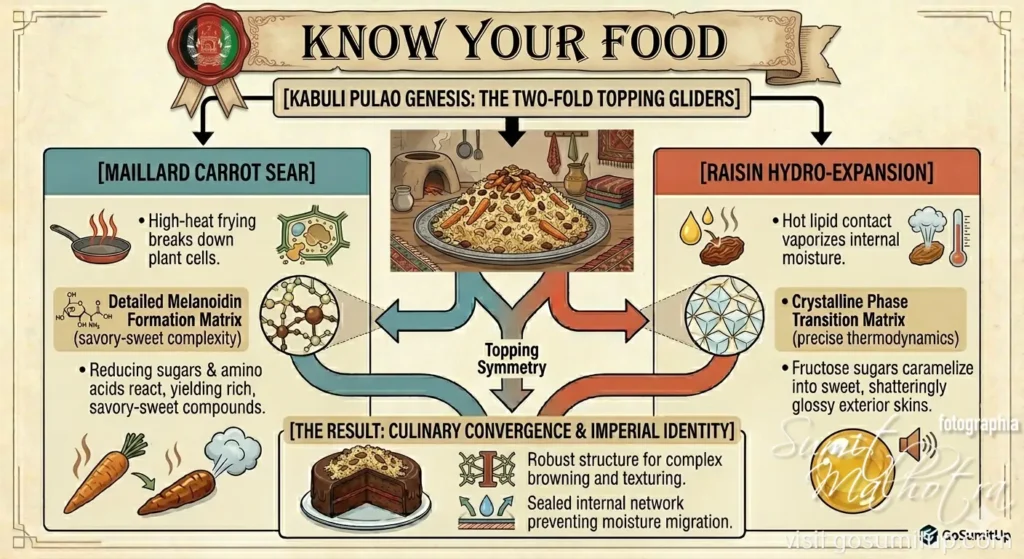
Kabuli pulao from afghanistan genesis
2. The Yakhni Base: Umami Extraction and Lipid Emulsification
The engine of flavour in an Afghani pulao is the Yakhni (broth), typically derived from tough, collagen-rich cuts of mutton or lamb.
Long, low-temperature simmering breaks down the tough collagen into gelatin.
When the raw rice is added to this simmering broth, the gelatin acts as a natural texturizer.
It increases the viscosity of the liquid, coating the grains and working alongside the cooking oil to form a smooth, protective shield.
This prevents the grains from sticking together during the final cook.
3. The Topping Mechanics: High-Heat Maillard and Sucrose Caramelisation
The defining identity of Kabuli Pulao lies in its signature garnish: julienned carrots and plump raisins (Kishmish).
This component is cooked completely separately from the rice to manage two distinct chemical reactions:
The carrots are fried in oil to trigger the Maillard reaction, turning the bitter, raw root notes into a rich, savoury-sweet complexity.
The raisins are tossed into the hot fat immediately after. The extreme heat causes the trace moisture inside the raisin to flash into steam, inflating it into a round sphere.
Simultaneously, the surface fructose sugars caramelise into a glossy, sweet skin that perfectly contrasts the deep, savoury elements of the meat.
4. The Dum Phase: Moisture Equilibrium
In the final Dum (steaming) phase, the par-cooked rice is piled into a conical mound, topped with the caramelised carrots, raisins, and a dust of sweet spices (cardamom and cumin).
The pot is sealed with a heavy cloth lid.
As the residual moisture moves upward, it finishes hydrating the rice starches.
The conical shape ensures that the condensing steam runs down the sides of the pot rather than pooling at the bottom, protecting the lower layers from becoming waterlogged.