
Origin of Curry | Is Curry Indian? – Read the history of curry powder and about the British influence on Indian food. Know why do we call Indian food curry?
If you walk into a restaurant in London, New York, or Tokyo and ask for “Indian food,” the conversation invariably turns to “Curry.”
It is a word that has become the global shorthand for an entire subcontinent’s culinary identity.
Yet, if you walk into a traditional home in Lucknow, Kochi, or Guwahati and ask what’s for dinner, the word “Curry” will rarely, if ever, be uttered.
You will hear of Salan, Ghol, Kootu, Saag, Pulusu, or Dal.
This brings us to one of the most successful linguistic and culinary deceptions in history: The “Curry” as a specific Indian dish does not exist.
It is a colonial construct—a British attempt to simplify a landscape of flavours so vast that it defied their vocabulary.
Paneer Masala Curry
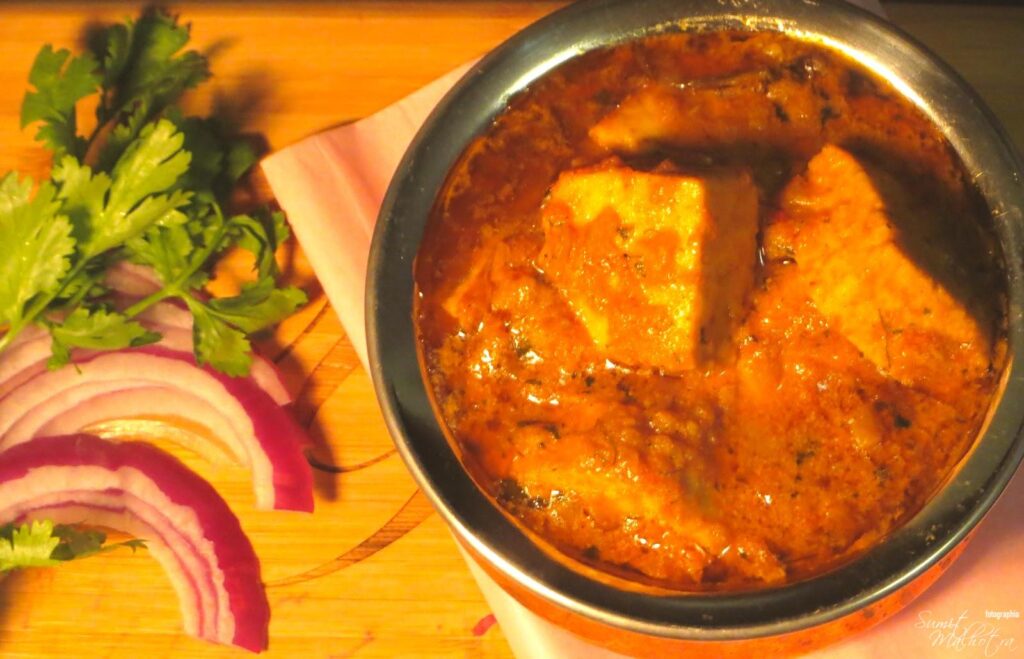
Today, in many tourist-heavy parts of India, restaurants serve "Curries".
The Etymological Root: From Kari to Curry
The etymology of curry or the genesis of the word “Curry” is a classic tale of “lost in translation.”
When the Portuguese and later the British East India Company arrived on the shores of South India in the 15th and 16th centuries, they encountered a diverse range of spiced, liquid-based dishes.
The most likely source of the word is the Tamil word “Kari,” which translates to “sauce” or “relish for rice.” So maybe there is no difference between kari and curry in preparation?
In the local context, Kari often referred to a specific preparation of meat or vegetables sautéed with spices—particularly black pepper and curry leaves (Kariveppila).
The British, struggling with the nuanced regional terminology of the Indian landscape, adopted “Kari” as a catch-all term. By the 1700s, the word had been “Anglicised” into Curry.
It became a linguistic bucket into which the British tossed every spiced gravy they encountered, whether it was a fiery vindaloo from Goa or a delicate, coconut-based stew from the Malabar coast.
The Creation of "Curry Powder": Standardizing the Unstandardizable
In traditional Indian kitchens, there is no such thing as a singular "Curry Powder."
In a traditional Indian kitchen, the idea of a “pre-mixed” spice powder used for every dish is culinary heresy. Indian cooking is built on the principle of Bespoke Spicing.
A Masala (spice blend) is crafted specifically for the ingredient it is meant to coat. So, there was no one in India who invented curry powder?
The spices for a hearty mutton dish are fundamentally different from those used for a light summer gourd.
However, as British officials returned to England from the “Jewel in the Crown,” they craved the flavours of the East.
They lacked the expertise to toast, grind, and balance individual spices like cumin, coriander, turmeric, and fenugreek.
The Solution? Commercialization. In the late 18th century, British merchants began selling pre-mixed “Curry Powder.”
This was a standardised, yellow, turmeric-heavy powder designed to provide a “generic” Indian flavour profile.
This invention was the final nail in the coffin for the authenticity of “Curry.” It turned a dynamic, living tradition of spice-play into a static, shelf-stable commodity.
The British "Curry House" Culture
After World War II, migrants from the Sylhet region of Bangladesh opened restaurants across the UK.
The myth of the “Curry” was further cemented by the rise of the British Curry House.
In the early 20th century, and surging after World War II, migrants from the Sylhet region of Bangladesh opened restaurants across the UK.
To cater to the British palate—which by then was conditioned to expect a dish called “Curry”—these restaurateurs created a standardised menu.
They invented dishes like Chicken Tikka Masala (often cited as Britain’s true national dish) and Phall, which have almost no historical precedent in rural India.
So, that’s the history of chicken tikka masala from its inception.
These dishes were designed to be “curries” in the British sense: a protein swimming in a thick, uniform, tomato-and-onion-based gravy.

The Global Feedback Loop: Re-Importing the Myth
Because "Curry" became a global brand, the Indian hospitality industry began to adopt.
One of the most fascinating aspects of the Curry Myth is how it has travelled back to India.
Because “Curry” became a global brand, the Indian hospitality industry began to adopt the term to cater to Western tourists.
Today, you will find “Chicken Curry” or “Fish Curry” on the menus of five-star hotels in Delhi and Mumbai.
This is a classic example of “The Pizza Effect“—where a cultural phenomenon is exported, transformed in a foreign land, and then re-imported back to its source, where it is accepted as an authentic tradition.
Debunking the Identity: Why It Matters
By dismantling the "Curry Myth," we give space to the real heroes of Indian cuisine
Calling Indian food “Curry” is like calling all European food “Soup.” It erases the geographical and cultural nuances that define the subcontinent.
The Geography of Fat: In the North, “curries” are often based on Ghee or Mustard Oil. In the South, they are built on Coconut Oil. In the West, Peanut Oil dominates.
The Souring Agents: A “Curry” in Bengal might use yoghurt; in Kerala, it uses Kudampuli (Malabar tamarind); in Goa, it uses vinegar; and in the North, it uses Amchoor (dried mango powder).
By dismantling the “Curry Myth,” we give space to the real heroes of Indian cuisine: the regional masterminds who have spent millennia perfecting the balance of heat, sourness, and aroma.
If you are a traveller and or just love to drive, you may find below a list of items that will fortify & thus enrich your travel experience.
I use many of these myself for my trips. They are modestly priced and quite important to keep handy.
- Travel Adapter – https://amzn.to/3A04EJp
- Action Camera – https://amzn.to/4eCSMfF
- Camera Mounts & Accessories – https://amzn.to/4eG4je2
- Dashcam – https://amzn.to/3U2j4Qc
- Neck Rest – https://amzn.to/3Y6ZP98
- Tyre Inflator – https://amzn.to/3U8HpDP
- Storage – https://amzn.to/3XVQFMI
- Car Laptop Charger – https://amzn.to/3XXMVdA
- Vacuum Cleaner Cordless – https://amzn.to/3Yo1hWd
- Air Mattress – https://amzn.to/4015Bvu
- Jack Ratchet Wrench – https://amzn.to/3YkxddO
- Cleaning Cloth Microfibre – https://amzn.to/3NIOFmt
- Rechargeable Solar LED Torch – https://amzn.to/3Yj4h5Y
- Electronics Accessories Organiser – https://amzn.to/3A04XUz
- Pocket Travel Data Transfer Tool – https://amzn.to/3zMTxnc
- Smart Tracker for Keys – https://amzn.to/3BTuIq0
- Camping Cookware Kit – https://amzn.to/3BIy0N3
- Sleeping Bag – https://amzn.to/3U7v2rP
GoSumItUp is a personal blog written and edited personally by me. All opinions expressed are my own, which are honest and have not been influenced by any means.
My reviews are dependent on the visits at the time, and revisits will be reviewed again as they may have a different experience or the same.
I am not a food critic nor do I consider myself as one; this platform allows me to write and review my own personal dining experiences, whether good or bad, delicious or not, all of which are honest and truthful opinions.
Suppose you disagree or agree with me at any point, or do not receive the same experiences as I have. In that case, I do not hold any responsibility as everyone will have their own experiences that they will encounter themselves.
I pay for all meals. However, if any meals or products have been sponsored or compensated or if I was a guest, it will be clearly disclosed at the end of each review.
All images on this blog are my own unless stated otherwise. If you wish to use any of my photography for any purposes, please do not use it without any written permission and give credit and/or link back to the website.
If you would like to send a product or any sponsors/endorsements, it may or may not be published and reviewed on the website.
If you wish to send any products or invitations for any media, press or collaborations, etc., consider if it is something related to the content of the website, and if you see fit, please visit the Contact page for contact details.
Thank You.
Thank you for visiting GoSumItUp! I hope you enjoy the reviews & recipes found at www.gosumitup.com.
This page consists of disclaimers regarding the recipe, its outcome, nutrition, and food handling safety decisions.
The recipes have been cooked and compiled by me for general information only and should not be used to diagnose or treat any medical condition/s.
This information is not intended to diagnose, treat, cure, or prevent any disease as well.
GoSumItUp.com has used all reasonable care in compiling the information but offers no warranty as to its accuracy or its use in any possible form.
Consult a doctor or other health care professional for diagnosis and treatment of any medical condition/s. For more details please refer to our disclosure policy.
If you like this article, you can let us know in the comments below or on social media using #gosumitup and tag @gosumitup on Facebook.
I am always happy to read your feedback, and if you liked the dish or if you made the dish. :)
Better still, take a picture and post it on Instagram and tag it as #gosumitup
Connect directly – You can also connect with me directly on my Instagram, Facebook or Pinterest.
And, keep visiting us for more of such awesomeness. Bookmark gosumitup.com into your web browser now or simply subscribe to our browser notifications.
