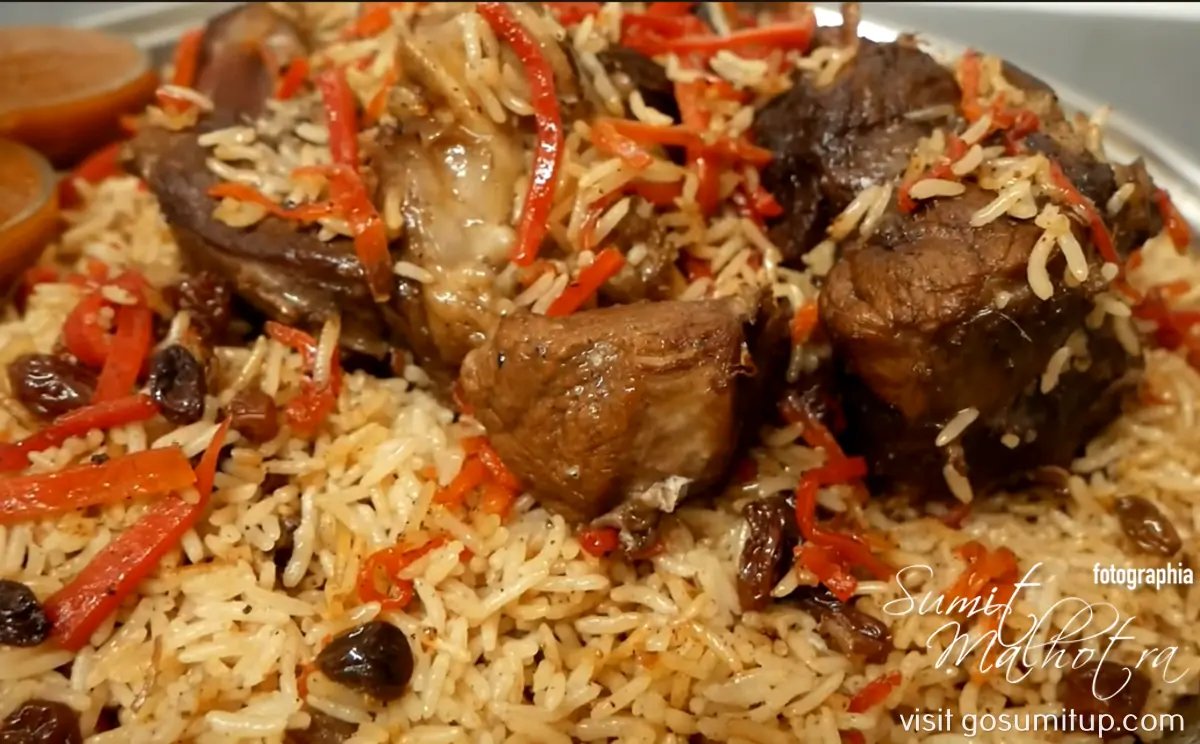
Origin of Kabuli Pulao – Read the history of Afghani Kabuli Pulao, one of the Famous Traditional Afghan Recipes & a Part of Silk Road Food History
In the narrow, smoke-filled alleys of Kabul’s old city, the aroma of caramelising carrots, toasted raisins, and slow-cooked lamb creates a sensory map that leads to one place: the Pulao-paz (the Pulao master).
Kabuli Pulao is the undisputed national dish of Afghanistan—a majestic mound of long-grain rice that seems to encapsulate the very soul of the nation.
However, a persistent myth has followed this dish through the centuries: the idea that it was born as a “poor man’s meal,” a clever way for street vendors to stretch meagre ingredients into a filling bowl for the working class.
But as we peel back the layers of history, we find that the truth is far more regal.
The story of Kabuli Pulao (History of Kabuli Pulao) is not one of poverty, but of imperial excess, diplomatic finesse, and the high art of the Silk Road kitchens.
Kabuli Pulao
The Aristocratic Roots: A Dish of the Durrani Empire
The myth of the "Poor Man's Meal" likely stems from the dish's current ubiquity.
The myth of the “Poor Man’s Meal” likely stems from the dish’s current ubiquity. Today, you can find Kabuli Pulao in humble roadside shacks across Afghanistan and Pakistan.
But in the 18th and 19th centuries, during the height of the Durrani Empire, this dish was reserved for the Sardars (nobles) and the royal court.
So that’s believed to be the origin of Afghani Pulao.
To understand why, one must look at the ingredients. Historically, the components of a true Kabuli Pulao were among the most expensive commodities in Central Asia:
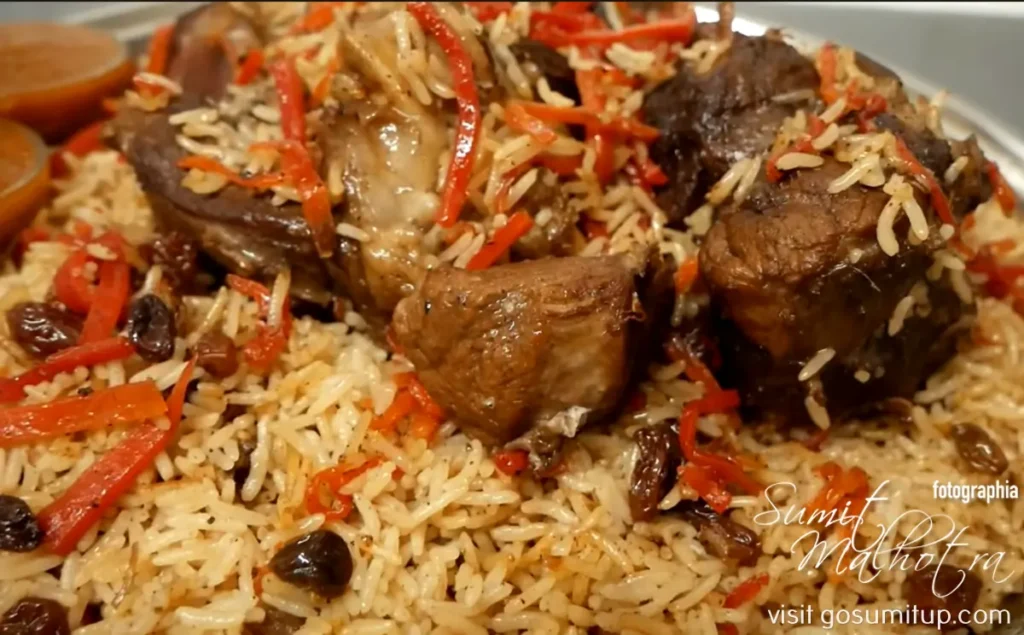
Sela Rice: Not just any rice, but the finest long-grain aged rice, often imported or grown in specific fertile valleys, which requires immense skill to cook without breaking.
The Meat: Large, tender chunks of lamb, specifically from the “choice cuts” of the shoulder or leg.
The Garnishes: The use of sugar to caramelise carrots and the addition of plump raisins and almond slivers were hallmarks of Persian-influenced luxury.
In an era where sugar was a prized import, using it to glaze vegetables was the ultimate “flex” of wealth.
The Science of the "Zard": The Chef’s Secret
The defining characteristic of a Kabuli Pulao is its deep, amber hue, known as Zard.
The defining characteristic of a Kabuli Pulao is its deep, amber hue, known as Zard.
There is a myth that this colour comes from simple browning or turmeric. In reality, the traditional method is a high-stakes culinary technique.
The Pulao-paz creates a caramelised sugar syrup (Qiwam). If the sugar is taken a second too far, it turns bitter; a second too short, and the rice remains pale.
This technique was developed in the royal kitchens of Kabul and Kandahar, where chefs competed to see who could produce the most vibrant, jewel-toned rice for the Emir’s table.
This level of precision is not the hallmark of a “quick street meal.” It is the result of centuries of professional culinary evolution within the palace walls.
The Migration: From the Palace to the "Charahi"
The transition happened as the Durrani Empire decentralized.
How did a royal dish become a “street” myth? The transition happened as the Durrani Empire decentralised.
As royal chefs sought work outside the palaces, they brought their secret techniques to the public squares (Charahis) of Kabul.
By the early 20th century, the growing middle class began to demand the tastes of the monarchy.
Street vendors adapted the recipe, sometimes using smaller portions of meat or local oils instead of pure sheep-fat, but keeping the “royal” aesthetic of carrots and raisins intact.
This democratisation of the dish led modern observers to assume it had always been a “food of the people.”
The Symbolism: More Than Just Food
In Afghan culture, Kabuli Pulao is a symbol of Hospitality (Melmastia).
In Afghan culture, Kabuli Pulao is a symbol of Afghan Hospitality (Melmastia).
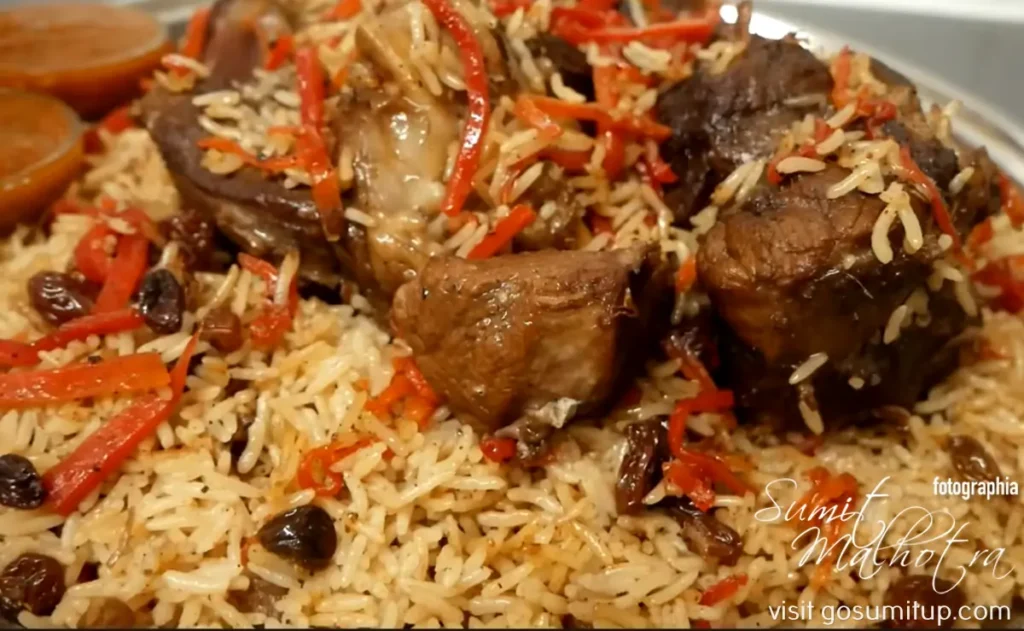
To serve a guest anything less than a Pulao topped with a generous portion of meat hidden beneath the rice is considered a social slight.
The myth that it is a “poor man’s food” is actually a testament to the Afghan spirit; even in times of hardship, the culture has fought to keep this “royal” standard accessible to everyone.
It is a dish that bridges the gap between the king and the commoner, ensuring that even a traveller with a few coins can taste the legacy of the Silk Road.
Kabuli Pulao was actually an aristocratic invention.
The myth of it being a "simple" dish arose because it is now available on every street corner.
Kabuli Pulao was actually an aristocratic invention.
Historically, only the wealthiest families in Kabul could afford the expensive combination of high-quality long-grain Sela rice, meat, and the “luxury garnishes” of caramelised carrots and raisins.
In the 18th and 19th centuries, the dish was a centrepiece of the Durrani Empire’s royal banquets.
If you are a traveller and or just love to drive, you may find below a list of items that will fortify & thus enrich your travel experience.
I use many of these myself for my trips. They are modestly priced and quite important to keep handy.
- Travel Adapter – https://amzn.to/3A04EJp
- Action Camera – https://amzn.to/4eCSMfF
- Camera Mounts & Accessories – https://amzn.to/4eG4je2
- Dashcam – https://amzn.to/3U2j4Qc
- Neck Rest – https://amzn.to/3Y6ZP98
- Tyre Inflator – https://amzn.to/3U8HpDP
- Storage – https://amzn.to/3XVQFMI
- Car Laptop Charger – https://amzn.to/3XXMVdA
- Vacuum Cleaner Cordless – https://amzn.to/3Yo1hWd
- Air Mattress – https://amzn.to/4015Bvu
- Jack Ratchet Wrench – https://amzn.to/3YkxddO
- Cleaning Cloth Microfibre – https://amzn.to/3NIOFmt
- Rechargeable Solar LED Torch – https://amzn.to/3Yj4h5Y
- Electronics Accessories Organiser – https://amzn.to/3A04XUz
- Pocket Travel Data Transfer Tool – https://amzn.to/3zMTxnc
- Smart Tracker for Keys – https://amzn.to/3BTuIq0
- Camping Cookware Kit – https://amzn.to/3BIy0N3
- Sleeping Bag – https://amzn.to/3U7v2rP
GoSumItUp is a personal blog written and edited personally by me. All opinions expressed are my own, which are honest and have not been influenced by any means.
My reviews are dependent on the visits at the time, and revisits will be reviewed again as they may have a different experience or the same.
I am not a food critic nor do I consider myself as one; this platform allows me to write and review my own personal dining experiences, whether good or bad, delicious or not, all of which are honest and truthful opinions.
Suppose you disagree or agree with me at any point, or do not receive the same experiences as I have. In that case, I do not hold any responsibility as everyone will have their own experiences that they will encounter themselves.
I pay for all meals. However, if any meals or products have been sponsored or compensated or if I was a guest, it will be clearly disclosed at the end of each review.
All images on this blog are my own unless stated otherwise. If you wish to use any of my photography for any purposes, please do not use it without any written permission and give credit and/or link back to the website.
If you would like to send a product or any sponsors/endorsements, it may or may not be published and reviewed on the website.
If you wish to send any products or invitations for any media, press or collaborations, etc., consider if it is something related to the content of the website, and if you see fit, please visit the Contact page for contact details.
Thank You.
Thank you for visiting GoSumItUp! I hope you enjoy the reviews & recipes found at www.gosumitup.com.
This page consists of disclaimers regarding the recipe, its outcome, nutrition, and food handling safety decisions.
The recipes have been cooked and compiled by me for general information only and should not be used to diagnose or treat any medical condition/s.
This information is not intended to diagnose, treat, cure, or prevent any disease as well.
GoSumItUp.com has used all reasonable care in compiling the information but offers no warranty as to its accuracy or its use in any possible form.
Consult a doctor or other health care professional for diagnosis and treatment of any medical condition/s. For more details please refer to our disclosure policy.
If you like this article, you can let us know in the comments below or on social media using #gosumitup and tag @gosumitup on Facebook.
I am always happy to read your feedback, and if you liked the dish or if you made the dish. :)
Better still, take a picture and post it on Instagram and tag it as #gosumitup
Connect directly – You can also connect with me directly on my Instagram, Facebook or Pinterest.
And, keep visiting us for more of such awesomeness. Bookmark gosumitup.com into your web browser now or simply subscribe to our browser notifications.
