The Science of Pulao: Absorption Mechanics and Starch Control
Pulao is defined by the one-pot absorption technique.
Unlike biryani—which relies on layered, par-boiled grain steaming—pulao requires raw rice to be toasted in fat before simmering in a precisely measured broth until the liquid is entirely absorbed.
This method ensures every single grain stands separate, unbroken, and infused with deep flavour.
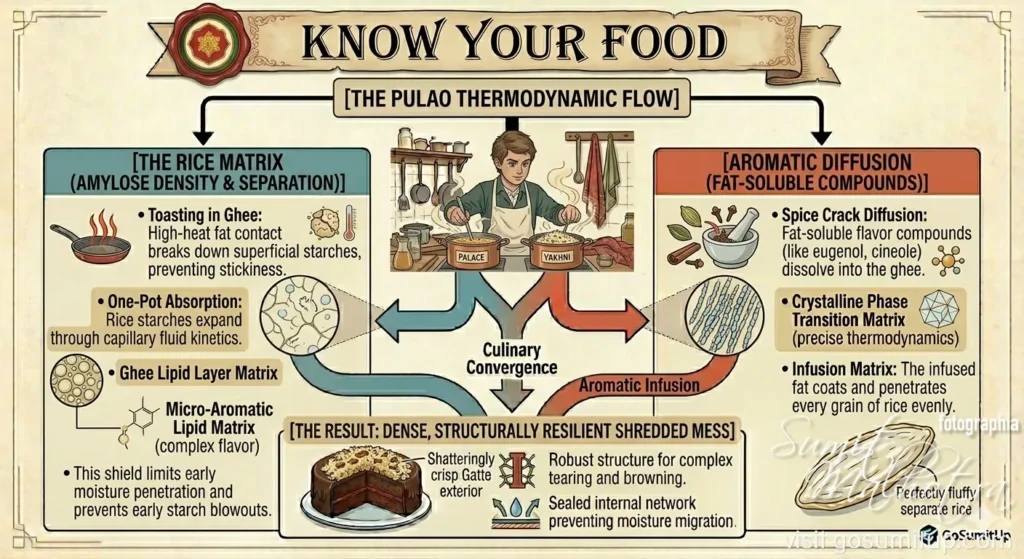
The pulao thermodynamic flow
1. Starch Engineering: Controlling Amylose
The structural success of a pulao depends on managing two starches within the rice endosperm: linear amylose and branched amylopectin.
To achieve fluffy, non-sticky grains, long-grain Basmati is preferred due to its high amylose content (around 22%).
Linear amylose molecules resist gelatinising and turning gummy when heated.
Before adding any liquid, the washed and dried rice undergoes fat-jacket cooking. Toasting the grains in hot ghee or oil coats each one in a hydrophobic lipid barrier.
This slows down early water absorption, preventing the outer cell walls from bursting and leaking excess sticky starches into the pot.
2. Fluid Dynamics and Steam Rest
Once toasted, a concentrated broth (yakhni) is introduced at a strict volume ratio—typically 1:2 or 1:1.75 of rice to liquid.
As the pot simmers under a tight lid, the rice absorbs the liquid through capillary action, swelling uniformly without losing structural integrity.
When the liquid disappears from the surface, the heat is turned off, but the pot must remain sealed for 10 to 15 minutes.
This steam-rest phase triggers starch retrogradation.
As the temperature cools slightly, the expanded amylose chains realign and firm up, locking the grain’s shape so it separates cleanly when fluffed.
3. Volatile Aromatic Diffusion
Pulao’s identity comes from the diffusion of fat-soluble flavour compounds. Whole spices like cardamom, cinnamon, and cloves are cracked directly into the cooking fat.
Because their essential aromatic compounds (like eugenol and cineole) are hydrophobic, they dissolve into the hot ghee, coating and flavouring every grain evenly.