Traditional Algerian Food Philosophy summarises the History of Algerian Couscous & the Origin of Rechta Pasta.
It also narrates the Berber Food Myths and the Numidian Culinary Traditions.
In the sun-baked markets of Algiers and across the high, windswept plateaus of Sétif, there is a saying that echoes through every kitchen: “Couscous is the Sultan of the Table.”
It is not merely a staple; it is a spiritual anchor, a symbol of baraka (blessing), and the heartbeat of North African identity.
For generations, a powerful myth has circulated among the Amazigh (Berber) communities of the Maghreb.
The legend claims that the art of rolling semolina into tiny, golden pearls is an 18,000-year-old inheritance.
An inheritance that is a gift from the prehistoric ancestors who roamed the Tassili n’Ajjer highlands long before the Sahara became a desert.
But as we sift through these “Golden Grains,” we uncover a fascinating tension between cultural legend and archaeological science.
Is couscous a relic of the Stone Age, or was it a revolutionary “high-tech” innovation of the medieval Berber kings?
So conclusively, it is not possible to define who invented Couscous: Algeria or Morocco?
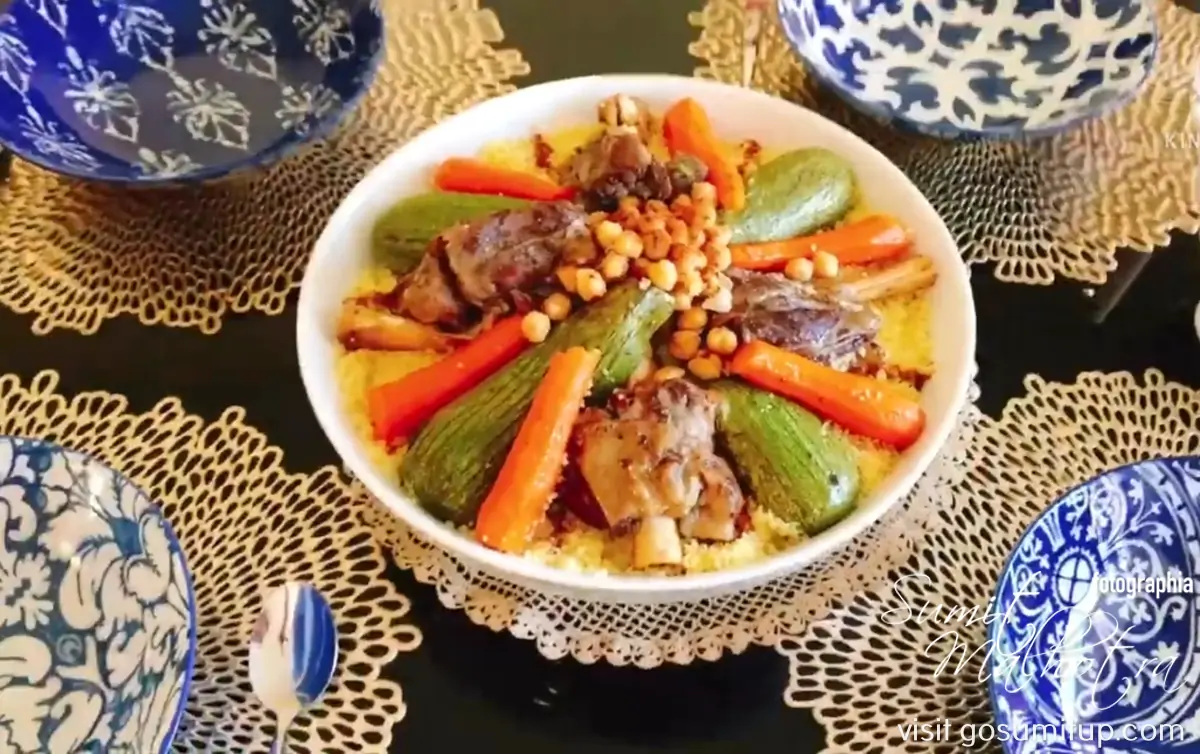
Algerian Couscous Served
The Numidian Legacy: The King’s Steamer
The true birth of the "Golden Grain" as we know it is tied to the Kingdom of Numidia (modern-day Northern Algeria).
If 18,000 years is a romantic stretch, the historical reality is still older than most European culinary traditions. And, so is the legend of King Masinissa’s food.
The true birth of the “Golden Grain” as we know it is tied to the Kingdom of Numidia (modern-day Northern Algeria).
Excavations of 3rd-century BCE tombs—specifically from the era of King Masinissa, the first great unifier of the Berber tribes—have revealed terracotta cooking pots with holes in the bottom.
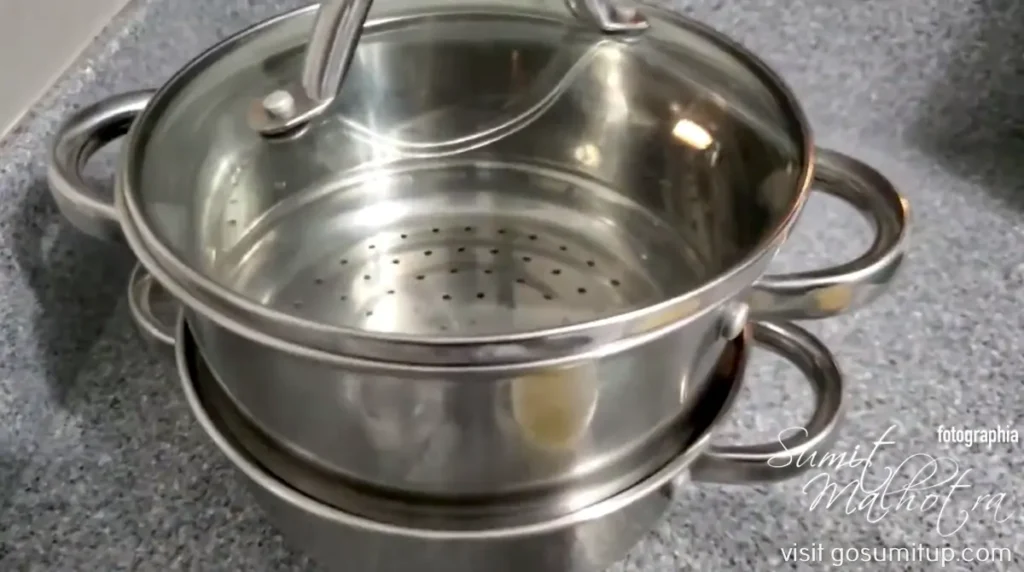
These are the world’s oldest Couscoussiers as per the History of the Couscoussier steamer.
Why was it revolutionary?
In the 2nd century BCE, Numidia was the “breadbasket of Rome.”
King Masinissa understood that for his cavalry and nomadic tribes to thrive, they needed a food that was:
Portable: Dried couscous can be stored for years without spoiling.
Fuel-Efficient: Steaming grain over a boiling stew uses half the wood required for baking bread in an oven.
Light: Unlike heavy bread, couscous is easy on the digestion, making it the perfect “warrior’s ration” for the desert.
This wasn’t an accident; it was an engineering marvel.
While the Romans were stuck eating heavy porridges (puls), the Algerians were eating light, fluffy, aerated semolina.
Couscoussier Steamer
The 18,000-Year Myth: Folklore vs. The Fossil Record
It suggests that the Berbers were master grain-processors before the rise of the Egyptian Pyramids.
The claim that couscous dates back to the Upper Palaeolithic era (around 16,000–18,000 BCE) is a cornerstone of modern North African pride.
It suggests that the indigenous people of Algeria were master grain-processors long before the rise of the Egyptian Pyramids or the Mesopotamian city-states.
The Evidence for the Myth:
Advocates of this timeline point to the discovery of ancient grinding stones and “mortars” in the caves of the Sahara.
These tools were undoubtedly used to crush wild grains and tubers.
Furthermore, the genetic lineage of North African wheat varieties is ancient, suggesting a very long relationship between the people and the land.
The Reality Check:
Archaeology, however, makes a distinction between processing grain and creating couscous.
To make couscous, you don’t just crush wheat; you must roll it into uniform granules and—crucially—steam it.
The Steaming Revolution: True couscous requires a two-tiered vessel: the bottom for the stew and a perforated top (the kiskas) for the grain.
The Archaeological Gap: While Neolithic Algerians were eating “porridge” or “flatbreads,” the specific physical evidence for a steaming vessel doesn’t appear in the record until much later.
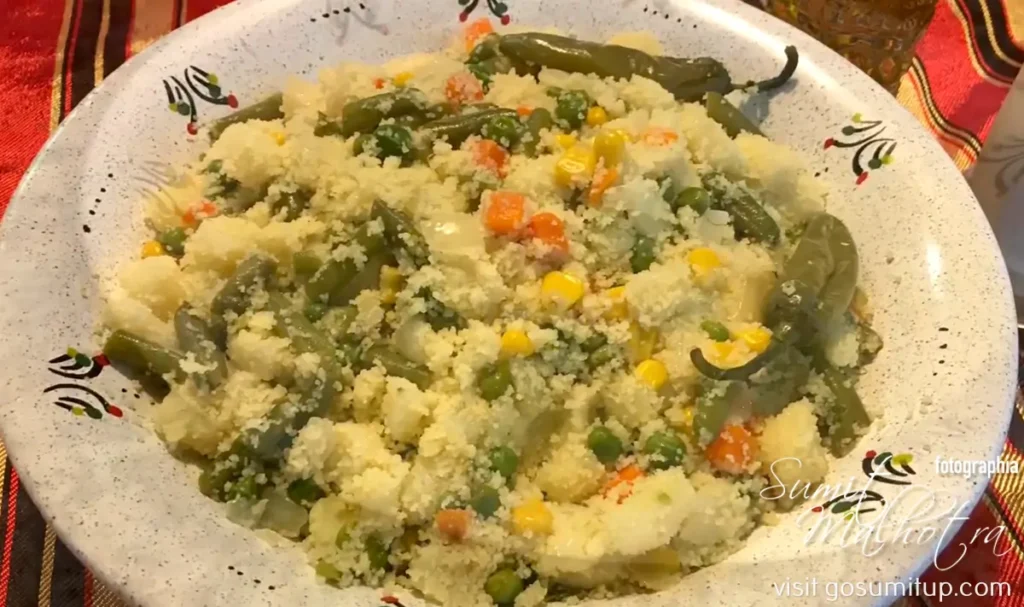
Algerian Vegetarian Couscous
The Myth of "Couscous Royale": The Colonial Invention
The myth sold to tourists is that this was the feast served in the palaces of the Algerian Beys.
If you walk into a “Maghrebine” restaurant in Paris today, the most expensive item is usually “Couscous Royale”—a mountain of grain topped with lamb, chicken, merguez sausages, and perhaps beef.
The myth sold to tourists is that this was the feast served in the palaces of the Algerian Beys.
The “Sumit Up” Truth:
In traditional Algerian homes, “Royale” is actually considered a modern, almost “un-Algerian” excess.
The Rule of One: Traditionally, Algerian couscous follows a strict rule of harmony.
You use one type of meat—lamb, chicken or fish—to ensure the flavours of the broth are pure.
The French Connection: The “Royale” was popularised by the Pieds-Noirs (European settlers) and the North African diaspora in 1960s France.
It was a way to showcase abundance in a restaurant setting.
The Traditional Way: In a village in the Aurès Mountains, a “royal” couscous isn’t about the number of meats; it’s about the quality of the Smën (aged clarified butter) and the freshness of the turnips and chickpeas.
Algerian Couscous with Soup & Lamb
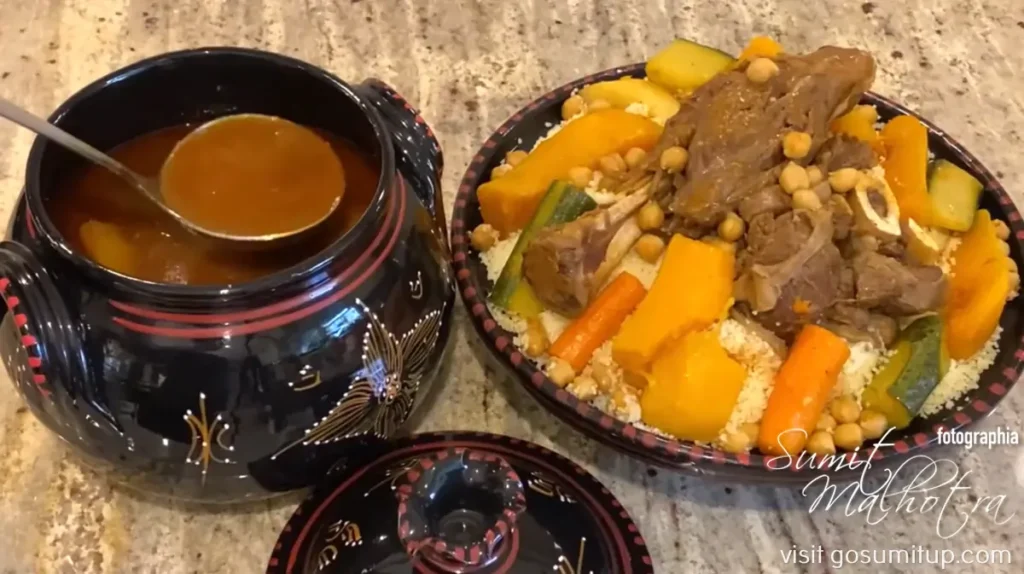
The "Sard" Myth: The Cooling Science of the Sahara
There is a persistent myth that couscous is a "Cooling" (Sard) grain that can heal the body during a desert heatwave.
Just as we explored in our Garm and Sard (Hot and Cold) analysis of Afghan food, Algerian cuisine is governed by an ancient thermal philosophy.
There is a persistent myth that couscous is a “Cooling” (Sard) grain that can heal the body during a desert heatwave.
The Culinary Reality:
While wheat is technically neutral, the Algerian method of preparation transforms it into a cooling agent.
Seffa: In the height of summer, Algerians serve couscous seffa.
It is a steamed grain served cold or at room temperature, mixed with cinnamon and raisins, and accompanied by a bowl of Lban (chilled fermented buttermilk).
The Probiotic Power: The Lban provides the “Sard” (Cold) nature, while the cinnamon regulates blood sugar.
It is the ultimate ancient “bio-hack” for surviving 40°C heat without feeling heavy or lethargic.
Rechta: The Myth of the “Mongol Pasta”
In Algiers, the most festive dish isn’t Couscous; it’s Rechta (authentic Algerian white sauce Rechta), thin, handmade noodles served in a delicate white cinnamon sauce.
A popular myth suggests that Rechta was brought to Algeria by the soldiers of Tamerlane or the Mongol Empire.
The Fact:
While the name Rechta has Persian roots (rishta meaning thread), the dish is uniquely Algerian.
It was first mentioned by the legendary historian Ibn Khaldun in the 14th century. He described it as a speciality of the Tlemcen region.
While the “Mongol” connection is likely a myth born of the Silk Road trade, it highlights Algeria’s historical position as a bridge between the East and the Mediterranean.
Algerian Couscous Dish
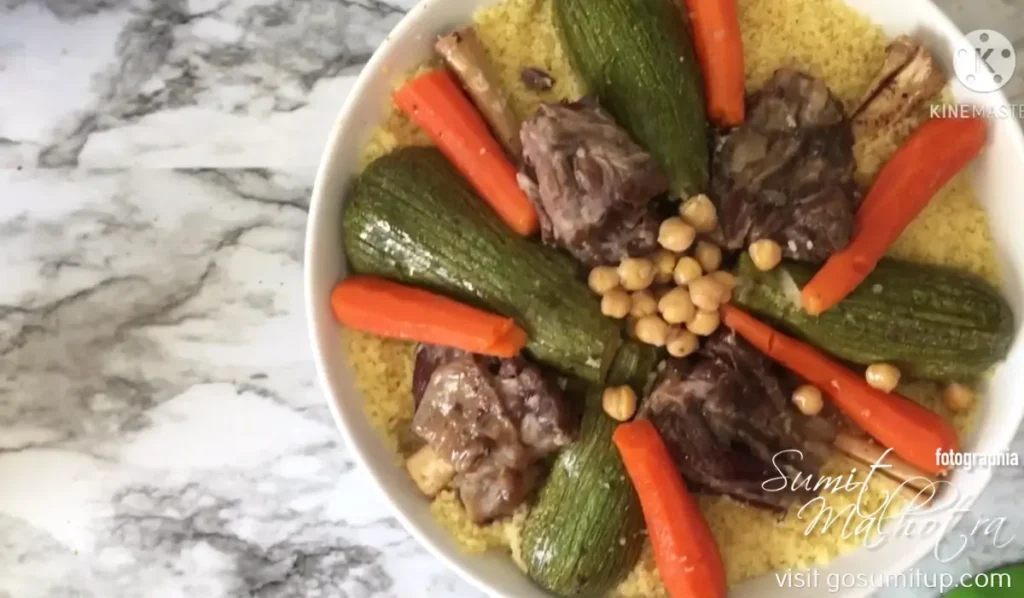
The Ritual of the Hand: A Living Legend
The final myth of couscous is that it "cannot be made by a machine."
The final myth of couscous is that it “cannot be made by a machine.”
While industrial couscous fills supermarket shelves, Algerian grandmothers insist that “machine-made grains have no soul.”
The Science of “The Roll”:
When a woman rolls semolina by hand, she is not just making a shape; she is creating surface area.
Hand-rolled granules are slightly irregular. These irregularities catch the steam and the sauce much better than perfectly smooth, machine-extruded factory grains.
This is why a handmade Algerian couscous will always feel “fluffier” and more flavorful—it is physically designed to absorb more of the meat’s essence.
Algerian Couscous
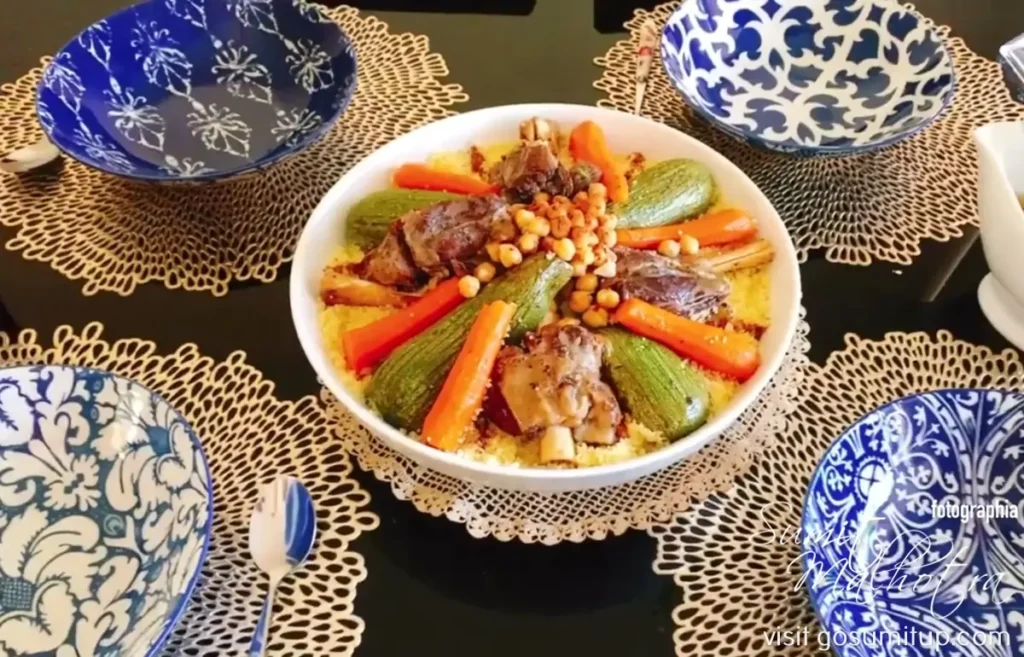
A "Sumit Up" Culinary Insight
The 18,000-year myth might be a legend, but the feeling of eating it? That is Eternal.
In Algeria, couscous is more than food; it is a Patience Meditation.
When you see a woman rolling grains for hours, she is participating in a chain of history that stretches back through the Ottomans, the Romans, and the Numidians.
Leading all the way to the first person who realised that steam could turn hard wheat into soft gold. And, we still don’t know is Couscous a 18000 year old dish?
The 18,000-year myth might be a legend, but the feeling of eating it? That is Eternal.
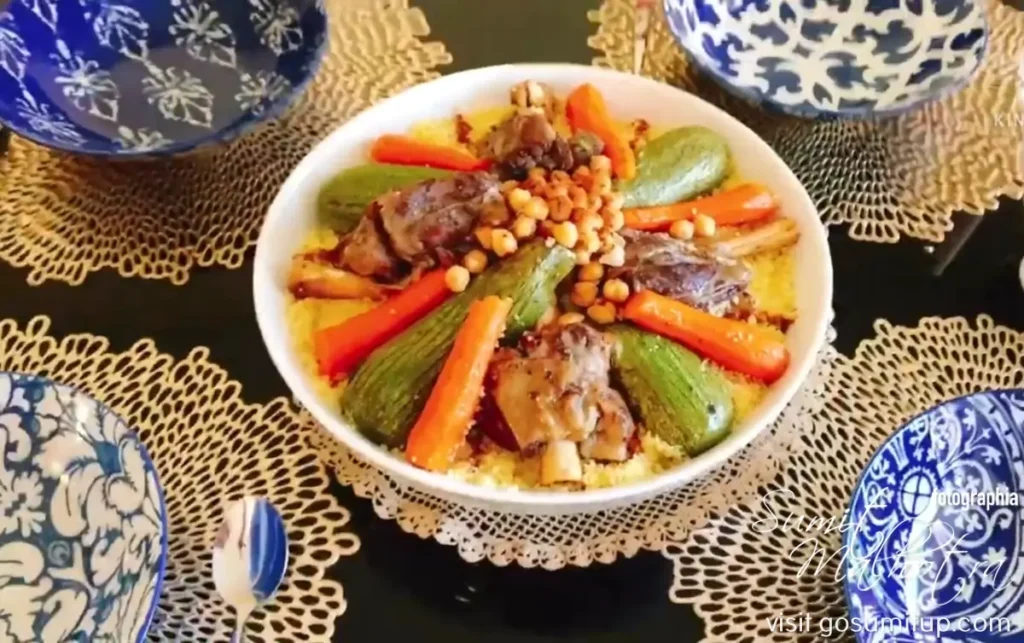
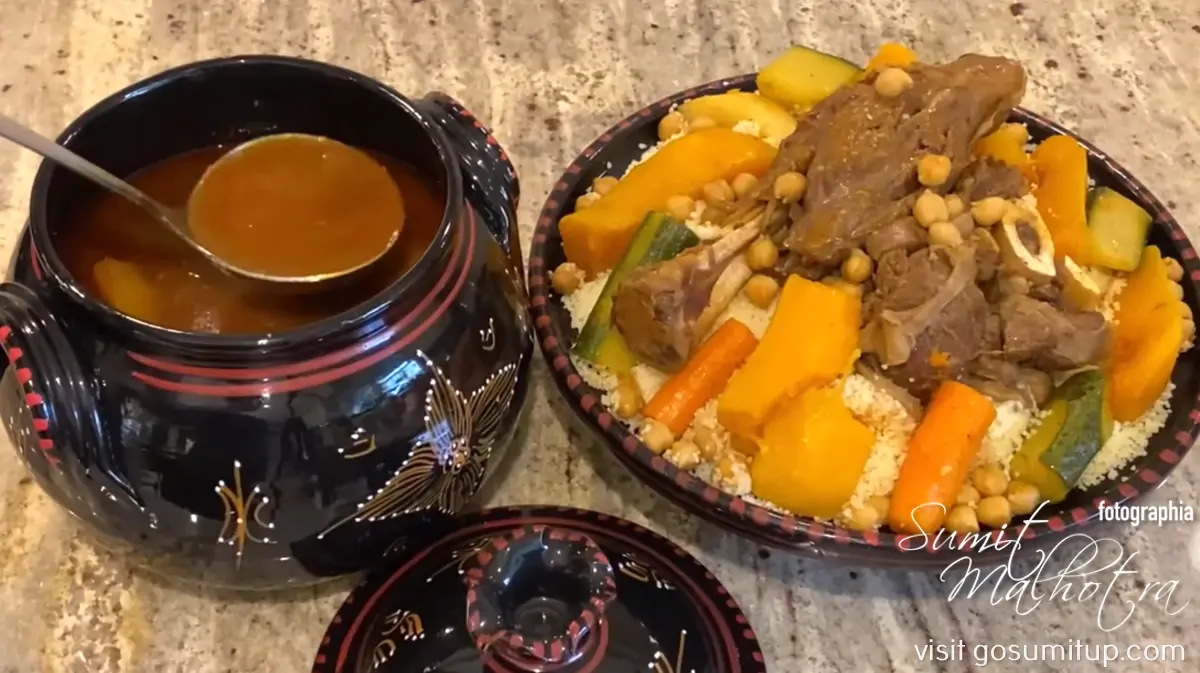
Algerian Couscous with Soup & Lamb
If you are a traveller and or just love to drive, you may find below a list of items that will fortify & thus enrich your travel experience.
I use many of these myself for my trips. They are modestly priced and quite important to keep handy.
- Travel Adapter – https://amzn.to/3A04EJp
- Action Camera – https://amzn.to/4eCSMfF
- Camera Mounts & Accessories – https://amzn.to/4eG4je2
- Dashcam – https://amzn.to/3U2j4Qc
- Neck Rest – https://amzn.to/3Y6ZP98
- Tyre Inflator – https://amzn.to/3U8HpDP
- Storage – https://amzn.to/3XVQFMI
- Car Laptop Charger – https://amzn.to/3XXMVdA
- Vacuum Cleaner Cordless – https://amzn.to/3Yo1hWd
- Air Mattress – https://amzn.to/4015Bvu
- Jack Ratchet Wrench – https://amzn.to/3YkxddO
- Cleaning Cloth Microfibre – https://amzn.to/3NIOFmt
- Rechargeable Solar LED Torch – https://amzn.to/3Yj4h5Y
- Electronics Accessories Organiser – https://amzn.to/3A04XUz
- Pocket Travel Data Transfer Tool – https://amzn.to/3zMTxnc
- Smart Tracker for Keys – https://amzn.to/3BTuIq0
- Camping Cookware Kit – https://amzn.to/3BIy0N3
- Sleeping Bag – https://amzn.to/3U7v2rP
GoSumItUp is a personal blog written and edited personally by me. All opinions expressed are my own, which are honest and have not been influenced by any means.
My reviews are dependent on the visits at the time, and revisits will be reviewed again as they may have a different experience or the same.
I am not a food critic nor do I consider myself as one; this platform allows me to write and review my own personal dining experiences, whether good or bad, delicious or not, all of which are honest and truthful opinions.
Suppose you disagree or agree with me at any point, or do not receive the same experiences as I have. In that case, I do not hold any responsibility as everyone will have their own experiences that they will encounter themselves.
I pay for all meals. However, if any meals or products have been sponsored or compensated or if I was a guest, it will be clearly disclosed at the end of each review.
All images on this blog are my own unless stated otherwise. If you wish to use any of my photography for any purposes, please do not use it without any written permission and give credit and/or link back to the website.
If you would like to send a product or any sponsors/endorsements, it may or may not be published and reviewed on the website.
If you wish to send any products or invitations for any media, press or collaborations, etc., consider if it is something related to the content of the website, and if you see fit, please visit the Contact page for contact details.
Thank You.
Thank you for visiting GoSumItUp! I hope you enjoy the reviews & recipes found at www.gosumitup.com.
This page consists of disclaimers regarding the recipe, its outcome, nutrition, and food handling safety decisions.
The recipes have been cooked and compiled by me for general information only and should not be used to diagnose or treat any medical condition/s.
This information is not intended to diagnose, treat, cure, or prevent any disease as well.
GoSumItUp.com has used all reasonable care in compiling the information but offers no warranty as to its accuracy or its use in any possible form.
Consult a doctor or other health care professional for diagnosis and treatment of any medical condition/s. For more details please refer to our disclosure policy.
If you like this article, you can let us know in the comments below or on social media using #gosumitup and tag @gosumitup on Facebook.
I am always happy to read your feedback, and if you liked the dish or if you made the dish. :)
Better still, take a picture and post it on Instagram and tag it as #gosumitup
Connect directly – You can also connect with me directly on my Instagram, Facebook or Pinterest.
And, keep visiting us for more of such awesomeness. Bookmark gosumitup.com into your web browser now or simply subscribe to our browser notifications.
