Balkh History, Meaning, Relevance, and Cultural Significance: Ancient City Guide
Discover the rich history of Balkh, the Mother of Cities. Learn its meaning, spiritual relevance in Zoroastrianism, Buddhism, and Islam, and modern-day usage.
Learn more about Balkh History, Meaning of Balkh, Mother of Cities, Um Al-Bilad, Bactra Ancient City, Silk Road Empires, Zoroaster in Balkh, Rumi Birthplace, Bactrian Kingdom, Central Asian History, Afghanistan, Ancient Empires, Bactria, Buddhism, Historical Cities, Islamic Golden Age, Silk Road, Sufism, Zoroastrianism
Introduction to Balkh: The Mother of Cities
Balkh stands as one of the oldest continuously inhabited cities in human history.
Located in modern-day northern Afghanistan, roughly 20 kilometres northwest of the provincial capital of Mazar-i-Sharif, this ancient urban centre was once known throughout the Eastern world as Um al-Bilad—the “Mother of Cities.”
Situated at the fertile delta of the Balkh Ab River in northern Bactria, Balkh served as a crucial nexus connecting South Asia, Central Asia, the Middle East, and East Asia along the ancient Silk Road.
From its origins as an Iranian tribal stronghold to its flowering as a Hellenistic kingdom, a major Buddhist monastic hub, and later a crown jewel of the Islamic Golden Age, Balkh has continually reshaped the cultural and intellectual contours of Eurasia.
Etymological Roots and Geographical Identity
The name Balkh traces its linguistic lineage back through millennia of Indo-Iranian language evolution:
Old Persian: Bākhtri- ──> Avestan: Bākhdhi ──> Greek: Bactra (Βάκτρα) ──> Middle Persian: Bahl ──> New Persian: Balkh (بلخ)
Geographically, Balkh sits on a well-watered alluvial plain south of the Amu Darya (Oxus) River.
The surrounding region, historically known as Bactria, provided ideal agricultural conditions amid the surrounding arid landscapes.
This unique geography allowed Balkh to sustain large populations, construct massive defensive walls, and establish itself as a mandatory stop for merchants, scholars, monks, and conquerors traversing the Asian landmass.
Historical Spectrum: From Antiquity to the Islamic Golden Age
Balkh’s historical journey spans several distinct civilizational epochs:
- The Avestan & Persian Era (c. 1000 BCE – 330 BCE): Balkh was a central node of the early Iranian tribes and an integral satrapy of the Achaemenid Empire. Tradition links the city directly to the prophet Zoroaster, who preached under the patronage of King Vishtaspa in Balkh.
- The Hellenistic & Bactrian Kingdom (330 BCE – 130 BCE): Following Alexander the Great’s conquest, Balkh (known to the Greeks as Bactra) became the capital of the Greco-Bactrian Kingdom. It became a vibrant melting pot of Greek, Persian, and Indian artistic traditions.
- The Kushan Empire & Buddhist Era (c. 1st Century CE – 7th Century CE): Under Kushan rule, Balkh transformed into an international centre of Mahayana and Theravada Buddhism. The famed Nava Vihara (New Monastery) was celebrated across Asia, attracting pilgrims such as the Chinese monk Xuanzang.
- The Islamic Era & Cultural Renaissance (7th Century CE – 13th Century CE): Following the Arab conquests, Balkh evolved into a brilliant centre of Islamic theology, science, mathematics, and Persian literature. It produced and nurtured legendary minds, including the philosopher Avicenna (Ibn Sina) and the mystic poet Jalal al-Din Muhammad Rumi.
- Mongol Destruction and Later History (1220 CE Onward): Genghis Khan’s invasion in 1220 CE devastated the city’s grand infrastructure and defensive walls. Though rebuilt under the Timurids and Bukharan rulers, Balkh gradually yielded its regional dominance to nearby Mazar-i-Sharif in the 19th century.
What Does Balkh Mean?
Linguistically, the word Balkh derives from the Avestan term Bākhdhi, recorded in the Vendidad (one of the primary texts of the Avesta) as Bākhdhi śrīra—meaning “Balkh the Beautiful” or “Balkh of the Lofty Banners.”
In its original Proto-Indo-Iranian and Old Persian contexts (Bākhtri-), the root is linked to concepts of “apportioned land,” “blessed territory,” or “flourishing domain.” Over centuries of phonetic softening:
- Old Persian Bākhtri- became the Greek Bactra or Bactria.
- Middle Persian (Pahlavi) shortened it to Bahl or Bahl-e-Bami.
- New Persian solidified the pronunciation into Balkh (بلخ).
Beyond literal etymology, “Balkh” functions culturally as a synonym for immemorial urban antiquity, primordial civilisation, and resilient heritage.
What is the Relevance of the Word Balkh?
The word Balkh carries profound historical, commercial, and intellectual relevance across multiple fields:
- Geopolitical & Trade Nexus: Historically, Balkh represented the crossroads of Asia. To speak of Balkh is to reference the hub where the northern branch of the Silk Road intersected trade routes leading south toward India and west toward Persia and Rome.
- Religious Convergence: Few words in historical geography capture such diverse spiritual layers. Balkh is relevant as:
- The early sanctuary and traditional site of the death of Zoroaster.
- A preeminent centre of Greco-Buddhist synthesis and monastic learning.
- A citadel of Sufism and Islamic scholarship, fostering early Persian literary revivals.
- Intellectual Benchmark: In medieval Islamic geography, referencing Balkh signified a centre of high learning, home to prestigious scholars like the astronomer Abu Ma’shar al-Balkhi and the early Sufi saint Ibrahim ibn Adham.
What is the Significance of the Word Balkh?
The significance of the word Balkh lies in its symbolic standing as an anchor of cultural identity and human achievement:
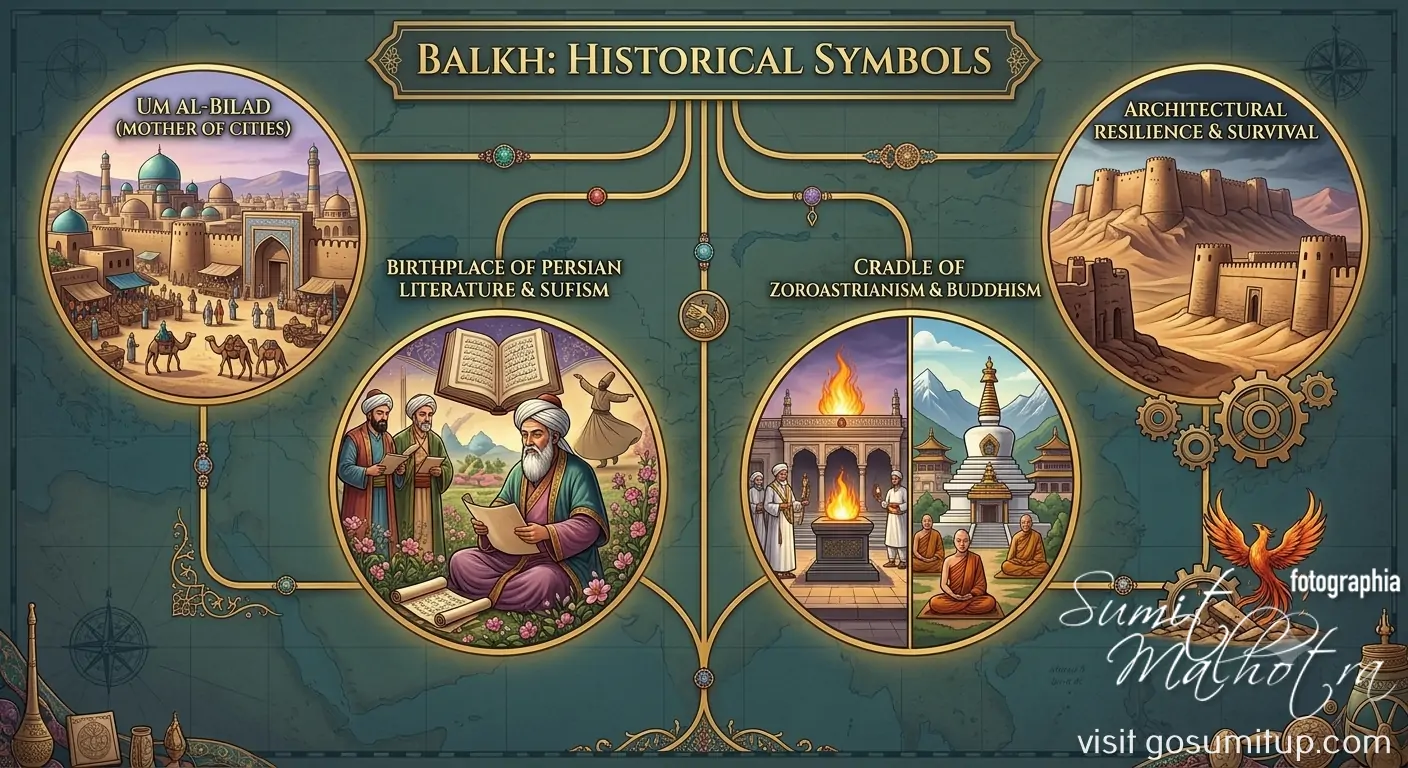
Balkh – historical symbols
- “Um al-Bilad” (Mother of Cities): Balkh was awarded this title in Arabic and Persian literature because it boasted urban infrastructure, defensive fortifications, and international commerce long before many contemporary imperial capitals were founded.
- Cradle of Classical Persian Literature: The word signifies the rebirth of New Persian poetry following the early Islamic period. Poets such as Rabia Balkhi—the first recorded female poet of New Persian literature—and Daqiqi Balkhi embedded the city’s name forever into the Persian literary canon.
- Symbol of Spiritual Transformation: In Sufi traditions, the story of Ibrahim ibn Adham, the King of Balkh who renounced his throne to become a mendicant ascetic, mirrors the story of the Buddha. The word Balkh thus symbolises the ultimate surrender of worldly power for spiritual illumination.
How is the Word Balkh Used?
The word Balkh is utilised across several distinct domains today:
- Administrative Geography: It denotes Balkh Province (Velāyat-e Balkh), a key administrative region in northern Afghanistan, as well as the modern district and small town of Balkh located within that province.
- Historiography & Archaeology: Historians and archaeologists use “Balkh” to refer specifically to the ancient walled citadel (Bala Hissar) and the surrounding archaeological complex containing layers of Bronze Age settlements, Hellenistic ramparts, Buddhist stupas (such as Top-e Rustam), and early Islamic mosques (such as the 9th-century Noh Gonbad Mosque).
- Literary Metaphor & Nisba: In Persian classical poetry and academic literature, Balkh is used metaphorically to represent ancient splendour, sacred memory, or lost grandeur. It also serves as a nisba (attributive surname)—e.g., al-Balkhi or Balkhi—attaching origin and prestige to historical figures like Rumi (Mavlānā Jalāl ad-Dīn Balkhī).
Who Uses the Word Balkh Today?
The name Balkh remains actively used by various global and local groups:
- Local Inhabitants & Afghan Citizens: Residents of northern Afghanistan use Balkh daily to designate their home province, district, and historical town, taking immense pride in its heritage.
- Persian-Speaking World (Greater Iran & Tajikistan): Scholars, poets, and citizens across Iran, Tajikistan, Afghanistan, and the broader diaspora frequently use “Balkh” in literature, history discussions, and cultural celebrations, revering it alongside cities like Samarkand, Bukhara, and Shiraz.
- Historians, Archaeologists, and Indologists: International academic communities study Balkh to analyse Silk Road trade networks, Greco-Buddhist art traditions, and early Iranian linguistics.
- Followers of Rumi & Sufi Orders: Spiritual practitioners and literary enthusiasts worldwide associate Balkh with the birthplace and spiritual roots of Jalal al-Din Rumi, referencing the city in lectures, translations, and biographical studies.
Cultural and Architectural Legacy of Balkh
Despite centuries of warfare and natural decay, physical monuments within Balkh still bear witness to its glorious past:
- Bala Hissar (The Citadel): The massive earthen ramparts of the ancient fortress still dominate the surrounding landscape, containing structural remains dating back to the Achaemenid and Hellenistic eras.
- Noh Gonbad Mosque (Nine Domes): Built in the 9th century, this structure is widely recognised as one of the earliest Islamic monuments in Central Asia. Its intricate carved stucco ornamentation reflects a transitional style combining Sasanian, Samanid, and early Abbasid architectural motifs.
- Khwaja Abu Nasr Parsa Shrine: A masterpiece of Timurid architecture featuring vibrant turquoise tilework, ribbed domes, and elegant calligraphic bands, dedicated to a prominent 15th-century Naqshbandi Sufi scholar.
- Tepe Rustam and Takht-e Rustam: Ancient earthen mounds representing the remnants of Balkh’s magnificent Buddhist past, including the colossal foundations of the famous Nava Vihara monastery complex.
Conclusion: The Enduring Spirit of Balkh
Balkh is far more than an ancient archaeological site; it is a living symbol of human cultural synthesis and historical resilience. From its early days as an Iranian sanctuary of Zoroastrian fire altars to its role as a Greco-Bactrian capital, a Buddhist sanctuary, and a citadel of Islamic philosophy and Persian poetry, Balkh earned its title as the Mother of Cities. Understanding the history, meaning, and ongoing relevance of Balkh offers a vital window into the shared heritage of Central Asia and the broader ancient world.