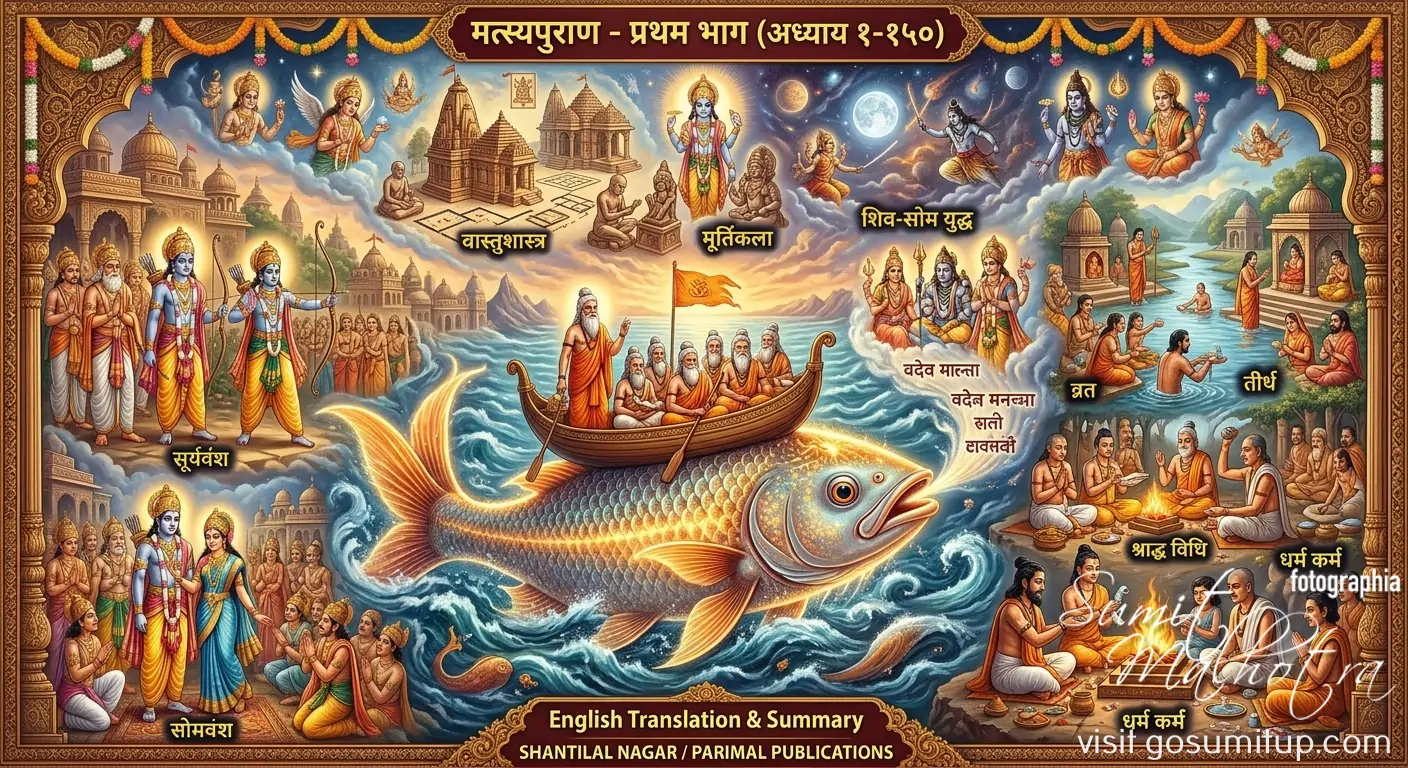
Introduction & Context of Matsya Purana Vol. 2
Matsya Purana Volume II transitions into intense epic narratives, detailed treatises on civil governance and more
Matsya Purana Vol 2 – Read a comprehensive synopsis of the Matsya Purāṇa (Vol. II, Chapters 151–291), detailing the birth of Skanda, Narasimha’s combat, royal dynasties, Vāstuśāstra, and Mahādānas.
Matsya Purana, Mahapurana, Hindu Mythology, Shantilal Nagar, Parimal Publications, Skanda, Narasimha Incarnation, Vastu Shastra, Hindu Scriptures, Epic Genealogies, Purana Synopsis, Matsya Purana, Hinduism, Puranas, Mythology, Lord Vishnu, Lord Shiva, Ancient India, Vedic Literature, Shantilal Nagar, Indian History, Matsya Mahapurana, Mahapuranas, Matsya Purana, Hindu Mythology, Lord Siva, Goddess Parvati, Lord Vishnu, Kartikeya, Tarakasura, Vastu Shastra, Ancient Indian History, Puranas, Sanskrit Literature, Rajadharma, Mahadana, Varanasi, Narmada River
Chapters 290 and 291 conclude the epic text. Chapter 290 details the cosmic time units (Kalpas), while Chapter 291 presents a concise summary of the entire Purāṇa, highlighting the merit (Phalaśruti) gained by reciting, studying, or preserving the text.
Ultimately, Volume II of the Matsya Purāna stands as a rich library of ancient wisdom, blending dramatic cosmological mythology with concrete manuals for socio-political governance, sacred geography, architecture, and spiritual rites.
Major Mythological Narratives & Cosmic Battles
Divine Incarnations and Cosmic Conflicts (Chapters 151–179)
The Devasur Sangram & Killing of Tārakāsura (Chapters 151–160)
The volume opens with a ferocious conflict between the gods (Devas) and demons (Dānavas). Lord Vishnu combats powerful Daitya generals like Nimi, Mathana, Jambha, and Mahiṣa.
Despite the heroic efforts of Vishnu and the Lokapālas (directional guardians), the demon king Tārakāsura overpowers the heavenly forces using invincible māyā and boon-derived strength, capturing Indra and locking the cosmos under tyrannical demonic rule.
The defeated gods seek refuge in Lord Brahmā, who reveals that Tārakāsura can only be slain by a seven-day-old child born of Lord Śiva.
This sets in motion a pivotal sequence of divine events:
- The Śiva-Pārvatī Narrative: Goddess Satī reincarnates as Pārvatī, daughter of Himācala and Menā. To break Śiva’s deep meditative Samādhi, Kāmadeva (Cupid) is deployed; however, Lord Śiva reduces Kāmadeva to ashes with his third eye.
- Pārvatī’s Penance: Pārvatī undertakes severe austerities to win Śiva as her husband. Impressed by her devotion, Śiva accepts her, leading to a grand divine marriage.
- Birth of Skanda/Kārtikeya: From the divine energy of Śiva and Pārvatī, Lord Kārtikeya (Skanda/Guha) is born and nurtured by the Kṛttikās. On the sixth day after his manifestation, Kārtikeya is anointed commander-in-chief of the celestial army and leads the Devas to victory, killing Tārakāsura in a decisive battle.
Incarnations of Lord Vishnu (Chapters 161–163, 244–248)
The text dives deep into several notable Avatāras of Lord Vishnu:
- Narasimha Avatara: Relates Hiranyakasipu’s intense tapas, Prahlāda’s divine devotion, the description of Narasimha’s terrifying half-man, half-lion form, and the final destruction of the demon king.
- Vāmana Avatara: Explains Vishnu assuming the form of a dwarf Brāhmaṇa to request three steps of land from King Bali, eventually measuring the entire earth, atmosphere, and heavens, and reclaiming the universe for Indra.
- Varāha Avatara: Details the Boar incarnation lifting the Earth (Bhavanī) out of the cosmic primordial waters.
Creation Myths & Samudra Manthan (Chapters 164–170, 249–251)
The narrative explores cosmic dissolutions (Pralaya) and creations.
It describes Vishnu sleeping upon the cosmic ocean (Ananta Śayana), the emergence of the golden lotus (Brahma-padma) from His navel, the birth of Brahmā, and the subsequent attack by the demons Madhu and Kaiṭabha.
Chapters 249–251 describe the churning of the milk ocean (Samudra Manthan) using Mount Mandara and the serpent Vāsuki to obtain the elixir of immortality (Amṛta).
Sacred Geography & Pilgrimage Guides (Māhātmya)
Vārāṇasī & Avimukta Kṣetra Māhātmya (Chapters 180–185): Exalts the glory of Vārāṇasī (Kāśī) as Lord Śiva’s eternal abode. It highlights that any soul departing this world within Avimukta Kṣetra attains instant liberation (Mokṣa) regardless of past karma.
Narmadā Māhātmya (Chapters 186–194): Dedicates nine chapters to the holy river Narmadā. It lists all sacred tīrthas along its banks, declaring that while a bath in the Gaṅgā purifies a person, the mere sight of the Narmadā cleanses all sins.
Genealogies, Lineages, and Prophecies of Royal Dynasties
The text details the genealogical branches (Pravaras) of major priestly families—including Bhrgu, Aṅgiras, Atri, Viśvāmitra, Kaśyapa, Vasiṣṭha, and Parāśara. It also establishes rules regarding matrimonial alliances, ancestral worship (Śrāddha), and duties toward ancestors (Pitṛs).
Chapters 271–273 serve as important historical references, recording ancient and future royal dynasties:
Solar & Lunar Dynasties: Genealogies of Ikṣvākus, Bṛhadrathas, and Pradyotas.
Historical Rulers: Lineages of the Śiśunāgas, Nandas, Mauryas, Śuṅgas, Kāṇvāyanas, and Andhra/Sātavāhana kings.
Kaliyuga Conditions: Forecasts the social, political, and ecological decay during Kaliyuga, detailing the rule of foreign invaders (Mlecchas, Yavanas) before cosmic order is restored at the turn of the cycle.
Governance, Ethics, and Royal Duties (Rājadharma)
King’s Duties & Officials: Qualities of a righteous monarch, ethical governance, and the selection of trustworthy ministers and servants.
Fortification & Urban Security: Detailed instructions on building defensive forts, stocking provisions, and safeguarding the city and royal palace.
Foreign Policy & Strategy: Application of the four political methods: Conciliation (Sāma), Concession/Gifts (Dāna), Division/Subterfuge (Bheda), and Force (Daṇḍa).
Penal System (Daṇḍa-nīti): Jurisprudential guidelines on inflicting appropriate punishments according to crime severity.
Fate vs. Human Effort (Chapter 221): A philosophical debate concluding that human effort (Puruṣārtha) and destiny (Daiva) are interdependent, though personal initiative remains paramount.
Vāstu Śāstra, Temple Architecture, and Iconography
Chapters 252 through 270 form a foundational manual for ancient Hindu architecture and sculpture:
Vāstu Vidyā chapters 252–257 detail site selection, land testing, soil examination, orientation, house planning, and propitiation of Vāstu Puruṣa.
Pratimā Lakṣaṇa consist of chapters 258–263 that detail proportions (Tālamāna), measurements, features, and stylistic traits for sculpting deities (Vishnu, Śiva, Brahmā, Devī, Ganeṣa, Surya, etc.) and Śiva-Liṅgas.
Consecration Rituals are in chapters 264–268 and detail Sacred rituals (Adhivāsana), idol purification baths, installation ceremonies, and peaceful rites for building foundations.
Temple Architecture in chapters 269–270 details the classification of temples into 20 structural styles, dimensional ratios, spire layouts, and assembly hall (Maṇḍapa) designs.
Sacred Rituals, Omens, and the Sixteen Great Gifts (Mahādānas)
Śānti & Expiatory Rites (Chapters 228–239): Ritual solutions to neutralise bad omens, nightmares (Duṣsvapna), planetary afflictions (Graha Śānti), contaminated water reservoirs, and unseasonal environmental anomalies.
The Sixteen Mahādānas (Chapters 274–289): Step-by-step instructions for conducting 16 acts of monumental charity:
- Tulā Puruṣa Dāna (Donating gold/valuables equal to one’s body weight).
- Hiraṇyagarbha Dāna (Golden womb gift).
- Brahmāṇḍa Dāna (Gift of the golden cosmic egg).
- Kalpapādapa Dāna (Gift of the wish-fulfilling tree).
- Gosahasra Dāna (Donation of 1,000 cows).
- Kāmadhenu, Hiraṇyāśva, Hema Hasti, and Earth Gifts.
- Saptasāgara & Ratna Dhenu Dāna (Gift of the seven ocean representations and jewel-cows).
Who wrote the Matsya Purana?
Who narrated the Matsya Purana?
-
Original Author / Composer: Maharṣi Śrī Kṛṣṇa Dvaipāyana Vyāsa (Sūta Gosvāmī narrating to the Ṛṣis in the Naimiṣāraṇya Forest).
English Translation: A Board of Scholars.
Exhaustive Introduction: Shantilal Nagar.
Editing & Scholarly Notes: K.L. Joshi
Who published the Matsya Purana?
Who are the publishers for Matsya Purana?
- Publisher: Parimal Publications, Delhi (India).
- Series: Parimal Sanskrit Series No. 93.
What is notable in the Matsya Purana?
Key Stories and Teachings of Matsya Purana
- The Tārakāsura Arc & Birth of Kartikeya: A detailed narrative of the battle between gods and demons, the burning of Kāmadeva, the asceticism of Pārvatī, her marriage to Śiva, and the birth of Skanda/Kārtikeya.
- Architectural & Sculptural Manuals (Vāstu Vidyā & Iconography): Detailed specifications for building cities, houses, temples, mandapas, and sculpting divine idols with exact measurements.
- Comprehensive Polity (Rājadharma): Detailed breakdown of statecraft, foreign policy (Sāma, Dāma, Bheda, Daṇḍa), fort preservation, and kingly codes.
- The 16 Great Donations (Mahādānas): Procedural instructions for performative charity, including Tulā Puruṣa and Hiraṇyagarbha.
- Historical Dynasties: Prophetic records listing ancient and future dynasties (Ikṣvākus, Mauryas, Śuṅgas, Andhras, etc.) up to the onset of Kaliyuga.
Why should we read the Matsya Purana?
What knowledge resides in the Matsya Purana?
Compendium of Ancient Knowledge: Bridges core Hindu mythology with applied ancient sciences—such as civil engineering, architecture, statecraft, and medicine/astrology.
Geographical & Cultural Mapping: Provides detailed pilgrimage maps (Māhātmya) for ancient holy sites like Vārāṇasī and the Narmadā River basin.
Historical Invaluable Insights: Serves as one of the primary Puranic benchmarks for historical chronology and royal genealogies in ancient India.
Spiritual & Ritualistic Guidance: Offers step-by-step instructions on personal ethics, kingly righteousness, architectural layout, and scriptural remedies (Śānti) against ill omens.
Disclaimer
If you like this article, you can let us know in the comments below or on social media using #gosumitup and tag @gosumitup on Facebook.
I am always happy to read your feedback, whether you liked the dish or made it. :)
Better still, take a picture and post it on Instagram and tag it as #gosumitup
Connect directly – You can also connect with me on Instagram, Facebook, or Pinterest.
And, keep visiting us for more of such awesomeness. Do bookmark gosumitup.com into your web browser now or simply subscribe to our browser notifications.
If you are an ardent traveller, you may find below a list of items that will fortify your travel experience. I use many of these myself for all my trips or roadtrips. They are modestly priced and quite important to keep handy for your safety.
- Travel Adapter – https://amzn.to/3A04EJp
- Action Camera – https://amzn.to/4eCSMfF
- Camera Mounts & Accessories – https://amzn.to/4eG4je2
- Dashcam – https://amzn.to/3U2j4Qc
- Neck Rest – https://amzn.to/3Y6ZP98
- Tyre Inflator – https://amzn.to/3U8HpDP
- Storage – https://amzn.to/3XVQFMI
- Car Laptop Charger – https://amzn.to/3XXMVdA
- Vacuum Cleaner Cordless – https://amzn.to/3Yo1hWd
- Air Mattress – https://amzn.to/4015Bvu
- Jack Ratchet Wrench – https://amzn.to/3YkxddO
- Cleaning Cloth Microfibre – https://amzn.to/3NIOFmt
- Rechargeable Solar LED Torch – https://amzn.to/3Yj4h5Y
- Electronics Accessories Organiser – https://amzn.to/3A04XUz
- Pocket Travel Data Transfer Tool – https://amzn.to/3zMTxnc
- Smart Tracker for Keys – https://amzn.to/3BTuIq0
- Camping Cookware Kit – https://amzn.to/3BIy0N3
- Rechargeable Electric Gas Lighter for Stoves – https://amzn.to/4orBsin
- Sleeping Bag – https://amzn.to/3U7v2rP
GoSumItUp is a personal blog written and edited personally by me. All opinions expressed are my own which are honest and have not been influenced by any means.
My reviews are dependent on the visits at the time and revisits will be reviewed again as they may have a different experience or the same.
I am not a food critic nor do I consider myself as one, this platform allows me to write and review my own personal dining experiences, may they be good or bad, delicious or not, all are honest and truthful opinions.
Suppose you disagree or agree with me at any point or do not receive the same experiences as I have. In that case, I do not hold any responsibility as everyone will have their own experiences that they will encounter themselves.
I pay for all meals. However, if any meals or product has been sponsored or compensated or if I was an invited guest, it will be clearly disclosed at the end of each review.
All images on this blog are my own unless stated otherwise. If you wish to use any of my photography for any purposes, please do not use it without any written permission and give credit and/or link back to the website.
If you would like to send a product or any sponsors/endorsements, it may or may not be published and reviewed on the website.
If you wish to send any products or invitations for any media, press or collaborations etc., consider if it is something related to the content of the website and if you see fit, please visit the Contact page for contact details.
Thank You.
Thank you for visiting GoSumItUp! I hope you enjoy the reviews & recipes found at www.gosumitup.com.
This page consists of disclaimers regarding the recipe, its outcome, nutrition, and food handling safety decisions.
The recipes have been cooked and compiled by me for general information only and should not be used to diagnose or treat any medical condition/s.
This information is not intended to diagnose, treat, cure, or prevent any disease as well.
GoSumItUp.com has used all reasonable care in compiling the information but offers no warranty as to its accuracy or its use in any possible form.
Consult a doctor or other health care professional for diagnosis and treatment of any medical condition/s. For more details please refer to our disclosure policy.
The nutritional and health information provided in this article is for educational and informational purposes only and is not intended as medical advice, diagnosis, or treatment.
While herbs have a long history of traditional and clinical use, individual health needs vary.
Always consult with a qualified healthcare professional, registered dietitian, or physician before introducing therapeutic doses of fenugreek into your daily diet, especially if you are pregnant, nursing, taking blood-thinning medications, or managing chronic conditions like diabetes.
