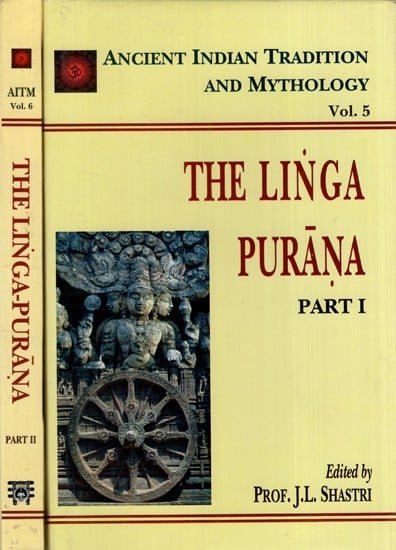
What is Linga Purana Part 1?
Read Linga Purana Part 1 of 2 - Linga Purana in English
Synopsis of Linga Purana, Lord Shiva, Shaivism, Pasupata Yoga, Hindu Scriptures, Puranas, Ancient Indian Mythology, Shiva Linga, Cosmogony, Vedic Rituals, Motilal Banarsidass, Linga Purana Part 1, Shaiva Puranas, Lord Shiva worship, Linga origin, Pasupata Yoga, Hindu cosmology, Ancient Indian mythology, Shiva Sahasranama, Linga Purana summary, Sanskrit translation, J L Shastri
The Linga Purana Part 1, edited by Prof. J. L. Shastri and translated by a Board of Scholars, forms Volume 5 of the Ancient Indian Tradition & Mythology series published by Motilal Banarsidass.
Derived from the Sanskrit collation published by Kşemarāja Śrīkrşņadāsa, this text is a major Shaiva Purana dedicated to revealing Lord Shiva in his unmanifest (nişkala) and manifest (sakala) forms.
Part 1 covers the first 95 chapters of Section I, detailing Shaiva philosophy, cosmogony, rituals, genealogical histories, and ancient geography.
The text begins in the sacred forest of Naimisha, where the sage Romaharshaṇa (Sūta), a disciple of Vyāsa, recites the Purana to gathering ascetics and the divine sage Nārada.
The philosophical foundation rests on the evolution of the Linga—the primary formless column of cosmic light that transcends the comprehension of both Brahmā and Vişņu.
The text defines a unique 27-tattva framework wherein Lord Maheśvara exists as the 27th supreme principle beyond the 24 elemental principles of Prakṛti, the individual soul (Jīva, 25th), and the cosmic soul (Puruşa, 26th).
Cosmologically, the text traces primary and secondary creation (Sarga and Pratisarga), describing the emergence of the Cosmic Egg (Brahmāņda), its seven sheaths, the three guņas, and time calculations spanning kāşţhās, muhūrtas, yugas, manvantaras, and kalpas.
It lists the 14 Manus, 28 historical Vyāsas, and 28 divine incarnations of Shiva as Yogeśvaras/Yogācāryas (such as Śveta and Lakulīśa) alongside their four disciples each, who preserve sacred wisdom across cycles of Kali Yuga.
The volume provides extensive descriptions of worldly geography, mapping the seven major continents (dvīpas), surrounding oceans, Mount Meru, Ilāvṛta, the Bhārata sub-continent, and the nether worlds (Pātāla).
This is complemented by an account of astronomical movements, detailing the solar chariot, lunar phases, planetary positions, and the central pivot of Dhruva (the Polar Star).
Genealogies of ancient Solar and Lunar dynasties are preserved, highlighting royal lineages and prominent figures such as Yayāti, Jyāmagha, and Śrīkṛşņa.
Spiritual and ritual practices form a major core of the volume, outlining Pāśupata Yoga, the eightfold path of Yoga (Aşţāńgayoga), ethical restraints (Yama and Niyama), holy ash applications (Bhasma), mental worship, the five-syllabled mantra (Namaḥ Śivāya), and the 1,000 names of Lord Shiva (Śiva Sahasranāma).
These teachings are punctuated by legends such as the defeat of Kşupa by Sage Dadhīca, the coronation of Nandīśvara, Sage Śveta’s triumph over Death (Kāla), and divine manifestations including Narasimha and the Varāha incarnation.
Who wrote the Linga Purana Part 1?
Who narrated the Linga Purana Part 1?
Traditionally, the compilation of the Linga Purana is attributed to the sage Vedavyāsa (Vyāsa). Within the narrative of the text itself, it is recited by his disciple, the sage Romaharshaṇa (Sūta), to the gathered ascetics and the divine sage Nārada in the Naimisha forest.
For the modern published edition titled The Linga Purana Part 1 (Volume 5 of the Ancient Indian Tradition & Mythology series by Motilal Banarsidass):
- Editor: Prof. J. L. Shastri
- Translators: A Board of Scholars
- Sanskrit Text Collation: Derived from the collation published by Kşemarāja Śrīkrşņadāsa
Who published the Linga Purana?
Who are the publishers for Linga Purana?
The Linga Purana has been published in various languages, formats, and translations by several major publishing houses:
- Motilal Banarsidass (MLBD): Publishes the widely cited, unabridged English translation across Volumes 5 and 6 of the Ancient Indian Tradition & Mythology series, edited by Prof. J. L. Shastri.
- Khemraj Shrikrishnadass / Venkateshwar Steam Press: Published foundational Sanskrit collations and classical print editions that served as primary reference texts for subsequent translations.
- Gita Press, Gorakhpur: Publishes popular Hindi translations, abridged versions, and narrative summaries designed for general readers and devotional study.
- Chowkhamba Sanskrit Series Office / Chowkhamba Academic Press: Offers scholarly Sanskrit editions, often accompanied by traditional commentaries and Hindi translations.
- Nag Publishers: Produces Sanskrit text editions alongside Hindi/English notes aimed at academic and research institutions.
- Mansukhray Mor (Gurumandal Series): Published historic Sanskrit compilations of the Purana as part of their comprehensive Puranic series.
What is notable in the Linga Purana Part 2?
The 27-Tattva Monistic Philosophy: The text introduces an expanded metaphysical classification in which Lord Maheśvara is established as the 27th principle (Saptaviṁśaka), transcending the 24 material principles of Pradhāna/Prakṛti, the 25th principle (Jīva), and the 26th principle (Puruṣa).
Cosmic Origin of the Linga Symbol: It describes the Linga as an infinite, formless pillar of light (Alinga/Nişkala) that reconciles disputes between Brahmā and Vişņu, establishing Shiva as the universe’s ultimate source, substrate, and point of dissolution.
Lineage of 28 Yogācāryas and Vyāsas: The Purana records a structured historical tradition listing 28 Vyāsas who compiled Vedic knowledge across Dvāpara ages, alongside 28 divine incarnations of Shiva as Yogeśvaras (ending with Lakulīśa) who descend with four main disciples each in every Kali age to propagate Pāśupata wisdom.
Systematic Exposition of Pāśupata Yoga: It outlines practical instructions on Pāśupata Yoga, detailing the eight ancillaries of yoga (Aşţāńgayoga), ethical vows (Yama and Niyama), ash ablution (Bhasmasnāna), and the esoteric mechanics of liberating bound souls (Pasus) by the supreme lord (Paśupati).
Comprehensive Puranic Geography and Astronomy: The text presents detailed ancient maps of the cosmos, including the structure of Mount Meru, the seven dvīpas, sub-continents like Bhārata, the nether regions, and astronomical movements of the Sun’s chariot, Moon, planets, and Dhruva.
Sacred Hymns and Mantras: Chapter 65 preserves the 1,000 names of Lord Shiva (Śiva Sahasranāma), alongside chapters expounding the spiritual efficacy and ritual application of the sacred five-syllable mantra (Namaḥ Śivāya).
Why should we read the Linga Purana Part 2?
What knowledge resides in Linga Purana Part 2?
Deep Philosophical Insight into Shaivism: Reading this text provides a direct understanding of monistic Shaiva theology, explaining how the absolute unmanifest reality (Nişkala) manifests as qualified creation (Sakala) through the emblem of the Linga.
Practical Guidance on Ethics and Spiritual Discipline: The text lays down clear ethical guidelines regarding non-violence (Ahimsā), truthfulness (Satya), cleanliness (Śauca), and self-control, offering a grounded guide for both ascetics and householders seeking mental purification.
Understanding Ancient Indian Cosmology and Time Cycles: It delivers a traditional perspective on the structure of the cosmos, cosmic time measurements (Yugas, Kalpas, and Manvantaras), and the cyclical nature of creation and dissolution.
Preservation of Sacred Hymns and Ritual Traditions: It serves as an authoritative source for classic Shaiva rituals, instructions on mental and physical worship, holy ablutions, and revered chants such as the Śiva Sahasranāma.
Rich Cultural and Allegorical Heritage: The narrative contains profound allegorical stories—such as Sage Dadhīca’s devotion, Sage Śveta overcoming Death, and the coronation of Nandi—which illustrate moral virtues, devotion (Bhakti), and the ultimate triumph of spiritual knowledge over illusion.
Disclaimer
If you like this article, you can let us know in the comments below or on social media using #gosumitup and tag @gosumitup on Facebook.
I am always happy to read your feedback, whether you liked the dish or made it. :)
Better still, take a picture and post it on Instagram and tag it as #gosumitup
Connect directly – You can also connect with me on Instagram, Facebook, or Pinterest.
And, keep visiting us for more of such awesomeness. Do bookmark gosumitup.com into your web browser now or simply subscribe to our browser notifications.
If you are an ardent traveller, you may find below a list of items that will fortify your travel experience. I use many of these myself for all my trips or roadtrips. They are modestly priced and quite important to keep handy for your safety.
- Travel Adapter – https://amzn.to/3A04EJp
- Action Camera – https://amzn.to/4eCSMfF
- Camera Mounts & Accessories – https://amzn.to/4eG4je2
- Dashcam – https://amzn.to/3U2j4Qc
- Neck Rest – https://amzn.to/3Y6ZP98
- Tyre Inflator – https://amzn.to/3U8HpDP
- Storage – https://amzn.to/3XVQFMI
- Car Laptop Charger – https://amzn.to/3XXMVdA
- Vacuum Cleaner Cordless – https://amzn.to/3Yo1hWd
- Air Mattress – https://amzn.to/4015Bvu
- Jack Ratchet Wrench – https://amzn.to/3YkxddO
- Cleaning Cloth Microfibre – https://amzn.to/3NIOFmt
- Rechargeable Solar LED Torch – https://amzn.to/3Yj4h5Y
- Electronics Accessories Organiser – https://amzn.to/3A04XUz
- Pocket Travel Data Transfer Tool – https://amzn.to/3zMTxnc
- Smart Tracker for Keys – https://amzn.to/3BTuIq0
- Camping Cookware Kit – https://amzn.to/3BIy0N3
- Rechargeable Electric Gas Lighter for Stoves – https://amzn.to/4orBsin
- Sleeping Bag – https://amzn.to/3U7v2rP
GoSumItUp is a personal blog written and edited personally by me. All opinions expressed are my own which are honest and have not been influenced by any means.
My reviews are dependent on the visits at the time and revisits will be reviewed again as they may have a different experience or the same.
I am not a food critic nor do I consider myself as one, this platform allows me to write and review my own personal dining experiences, may they be good or bad, delicious or not, all are honest and truthful opinions.
Suppose you disagree or agree with me at any point or do not receive the same experiences as I have. In that case, I do not hold any responsibility as everyone will have their own experiences that they will encounter themselves.
I pay for all meals. However, if any meals or product has been sponsored or compensated or if I was an invited guest, it will be clearly disclosed at the end of each review.
All images on this blog are my own unless stated otherwise. If you wish to use any of my photography for any purposes, please do not use it without any written permission and give credit and/or link back to the website.
If you would like to send a product or any sponsors/endorsements, it may or may not be published and reviewed on the website.
If you wish to send any products or invitations for any media, press or collaborations etc., consider if it is something related to the content of the website and if you see fit, please visit the Contact page for contact details.
Thank You.
Thank you for visiting GoSumItUp! I hope you enjoy the reviews & recipes found at www.gosumitup.com.
This page consists of disclaimers regarding the recipe, its outcome, nutrition, and food handling safety decisions.
The recipes have been cooked and compiled by me for general information only and should not be used to diagnose or treat any medical condition/s.
This information is not intended to diagnose, treat, cure, or prevent any disease as well.
GoSumItUp.com has used all reasonable care in compiling the information but offers no warranty as to its accuracy or its use in any possible form.
Consult a doctor or other health care professional for diagnosis and treatment of any medical condition/s. For more details please refer to our disclosure policy.
The nutritional and health information provided in this article is for educational and informational purposes only and is not intended as medical advice, diagnosis, or treatment.
While herbs have a long history of traditional and clinical use, individual health needs vary.
Always consult with a qualified healthcare professional, registered dietitian, or physician before introducing therapeutic doses of fenugreek into your daily diet, especially if you are pregnant, nursing, taking blood-thinning medications, or managing chronic conditions like diabetes.
