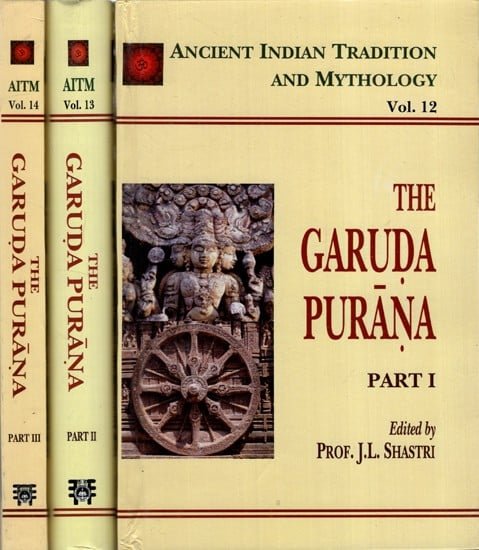
What is Garuda Purana Part 1?
Read Garuda Purana Part 1 of 2 - Brahma Purana in English
Synopsis of Garuda Purana, Garuda Purana Part 1, Lord Vishnu, Avatars of Vishnu, Vishnu Sahasranama, Visnupanjarastotra, Hindu Cosmology, Vaishnavism, Puranic Lineages, Sacred Mantras, Vedic Rituals, Motilal Banarsidass, Suta Goswami, Sage Vyasa, Vajranabha Mandala
The Garuda Purana Part 1 is a foundational Mahapurana that systematically outlines Vaishnava cosmology, theology, ritualistic procedures, genealogies, and devotional hymns.
The text is structured as a dialogue recounted by the sage Suta to Saunaka and other ascetics assembled in the Naimisa forest.
Suta transmits the knowledge originally received from Vyasa, who was taught by Brahma, who in turn learned it from Lord Vishnu alongside Rudra.
The core lore originates from Lord Vishnu granting a boon to his divine carrier, Garuda, who undertook severe austerities to free his mother, Vinata, from slavery to serpents and gain omniscience.
Key Themes and Contents
- Manifestations and Avatars of Vishnu: The text begins by praising Lord Vishnu as the supreme, omnipresent, un-ageing soul and detailing his divine incarnations. It enumerates various manifestations, including Kumara, the Boar (Varaha), Narada, Nara-Narayana, Kapila, Dattatreya, Yajna, Prthu, Matsya, Kurma, Dhanvantari, Mohini, Narasimha, Vamana, Parasurama, Vyasa, Rama, Balarama, Krsna, Buddha, and the future incarnation Kalki.
- Cosmology and Creation (Sarga and Pratisarga): Vishnu explains the mechanics of cosmic evolution from the unmanifest Brahman to the elements, mind, intellect, and the cosmic golden egg (Garuda). The narrative categorises four main types of creation covering nine divisions, encompassing primary (prakrta) and secondary (vaikrta) creations, sub-human beings, super-human gods, and human beings.
- Lineages of Progenitors and Deities: Detailed genealogies are presented for the mind-created sons of Brahma, the Prajapatis (such as Daksa, Marici, Bhrgu, and Vasistha), and their offspring. It tracks the lineages of Aditi, Diti, Danu, Vinata, and Kadru, explaining the origins of the twelve Adityas, eleven Rudras, eight Vasus, Maruts, heavenly nymphs (Apsarasas), demigods, and various living creatures. It also recounts famous Puranic episodes, such as King Vena’s tyranny, the birth and reign of King Prthu, and Daksa’s sacrifice.
- Sacred Rituals, Mandalas, and Consecration: A significant portion of the work provides prescriptive instructions for daily religious rites. This includes solar worship (Surya-puja), the construction and colour schemes of the Vajranabha mystic diagram (mandala), the procedure for spiritual initiation (Vishnu-diksa), Nava-vyuha worship, and the propitiation of goddesses such as Lakshmi and Sarasvati.
- Hymns, Protection Mantras, and Meditation: The volume features prominent devotional literature, including the Visnupanjarastotra—an invocatory prayer designed to form a protective spiritual armour using Vishnu’s weapons and forms—and the Visnu-sahasra-nama-stotra, which contains one thousand sacred names of Lord Vishnu recited to liberate seekers from the cycle of worldly existence. It concludes with instructions on Yoga and meditation focused on realizing the non-dual, unsullied inner Self.
Who wrote the Garuda Purana?
Who narrated the Garuda Purana?
Traditional View: Attributed to Maharishi Ved Vyasa (Krishna Dvaipayana), the sage credited with compiling the Vedas and authoring the 18 Mahapuranas.
Historical View: It is a composite text built over generations by numerous anonymous scholars, priests, and compilers. The material in Part 1 was assembled and edited between the early 1st millennium CE and roughly the 8th–11th centuries CE.
Who published the Garuda Purana?
Who are the publishers for Garuda Purana?
As an ancient Sanskrit text, it was initially preserved through oral tradition and handwritten palm-leaf manuscripts. In modern times, several scholarly and religious institutions have published critical editions and translations:
- Motilal Banarsidass (MLBD): Published the full English translation as part of the multi-volume Ancient Indian Tradition and Mythology series (edited by scholars such as J.L. Shastri).
- Gita Press, Gorakhpur: The primary publisher of popular Hindi and Sanskrit editions distributed across India.
- Chowkhamba Sanskrit Series Office & Nirnaya Sagar Press: Prominent academic publishers responsible for early Sanskrit recensions and commentaries.
- Manmatha Nath Dutt (1908): Published one of the earliest complete English translations of the text.
What is notable in the Garuda Purana Part 1?
The first volume (known as the Purva Khanda) of the Garuda Purana is a vast encyclopaedic text comprising over 200 chapters.
Framed as a dialogue between Lord Vishnu and his bird-vehicle, Garuda, it covers a wide spectrum of spiritual, scientific, and practical knowledge:
-
Cosmology and Theology: The creation of the universe, genealogies of gods and sages, and praise of Lord Vishnu along with other deities.
-
Rituals and Devotion: Instructions for daily worship, temple design, idol consecration, vows (vratas), and sacred mantras.
-
Secular Sciences: Comprehensive details on traditional Indian medicine (Ayurveda), gemology (Ratna Pariksha), astronomy, astrology, and grammar.
-
Ethics and Governance: Principles of virtue (dharma), duties according to life stages (varnashrama), and rules of conduct for kings and householders.
Notable Features of the Garuda Purana Part 1
-
Misconception vs Reality: Whilst the Garuda Purana is famous in popular culture for its descriptions of death, hells, and funeral rites, these topics are found almost entirely in Part 2 (Uttara Khanda or Preta Khanda). Part 1 accounts for roughly 80–90% of the complete text and is dedicated to life, health, ethics, and practical wisdom.
-
Ancient Gemology (Ratna Pariksha): It features specialised chapters evaluating the quality, origins, cuts, and flaws of precious gemstones like diamonds, rubies, emeralds, and pearls.
-
Ayurveda and Veterinary Science: It includes extensive sections on diagnosing human ailments, herbal remedies, and specialised veterinary treatments for horses (Ashvayurveda) and elephants (Hastyayurveda).
-
Holistic Synthesis: It serves as a 1st-millennium manual for living, combining religious devotion with the empirical sciences of ancient India.
Disclaimer
If you like this article, you can let us know in the comments below or on social media using #gosumitup and tag @gosumitup on Facebook.
I am always happy to read your feedback, whether you liked the dish or made it. :)
Better still, take a picture and post it on Instagram and tag it as #gosumitup
Connect directly – You can also connect with me on Instagram, Facebook, or Pinterest.
And, keep visiting us for more of such awesomeness. Do bookmark gosumitup.com into your web browser now or simply subscribe to our browser notifications.
If you are an ardent traveller, you may find below a list of items that will fortify your travel experience. I use many of these myself for all my trips or roadtrips. They are modestly priced and quite important to keep handy for your safety.
- Travel Adapter – https://amzn.to/3A04EJp
- Action Camera – https://amzn.to/4eCSMfF
- Camera Mounts & Accessories – https://amzn.to/4eG4je2
- Dashcam – https://amzn.to/3U2j4Qc
- Neck Rest – https://amzn.to/3Y6ZP98
- Tyre Inflator – https://amzn.to/3U8HpDP
- Storage – https://amzn.to/3XVQFMI
- Car Laptop Charger – https://amzn.to/3XXMVdA
- Vacuum Cleaner Cordless – https://amzn.to/3Yo1hWd
- Air Mattress – https://amzn.to/4015Bvu
- Jack Ratchet Wrench – https://amzn.to/3YkxddO
- Cleaning Cloth Microfibre – https://amzn.to/3NIOFmt
- Rechargeable Solar LED Torch – https://amzn.to/3Yj4h5Y
- Electronics Accessories Organiser – https://amzn.to/3A04XUz
- Pocket Travel Data Transfer Tool – https://amzn.to/3zMTxnc
- Smart Tracker for Keys – https://amzn.to/3BTuIq0
- Camping Cookware Kit – https://amzn.to/3BIy0N3
- Rechargeable Electric Gas Lighter for Stoves – https://amzn.to/4orBsin
- Sleeping Bag – https://amzn.to/3U7v2rP
GoSumItUp is a personal blog written and edited personally by me. All opinions expressed are my own which are honest and have not been influenced by any means.
My reviews are dependent on the visits at the time and revisits will be reviewed again as they may have a different experience or the same.
I am not a food critic nor do I consider myself as one, this platform allows me to write and review my own personal dining experiences, may they be good or bad, delicious or not, all are honest and truthful opinions.
Suppose you disagree or agree with me at any point or do not receive the same experiences as I have. In that case, I do not hold any responsibility as everyone will have their own experiences that they will encounter themselves.
I pay for all meals. However, if any meals or product has been sponsored or compensated or if I was an invited guest, it will be clearly disclosed at the end of each review.
All images on this blog are my own unless stated otherwise. If you wish to use any of my photography for any purposes, please do not use it without any written permission and give credit and/or link back to the website.
If you would like to send a product or any sponsors/endorsements, it may or may not be published and reviewed on the website.
If you wish to send any products or invitations for any media, press or collaborations etc., consider if it is something related to the content of the website and if you see fit, please visit the Contact page for contact details.
Thank You.
Thank you for visiting GoSumItUp! I hope you enjoy the reviews & recipes found at www.gosumitup.com.
This page consists of disclaimers regarding the recipe, its outcome, nutrition, and food handling safety decisions.
The recipes have been cooked and compiled by me for general information only and should not be used to diagnose or treat any medical condition/s.
This information is not intended to diagnose, treat, cure, or prevent any disease as well.
GoSumItUp.com has used all reasonable care in compiling the information but offers no warranty as to its accuracy or its use in any possible form.
Consult a doctor or other health care professional for diagnosis and treatment of any medical condition/s. For more details please refer to our disclosure policy.
The nutritional and health information provided in this article is for educational and informational purposes only and is not intended as medical advice, diagnosis, or treatment.
While herbs have a long history of traditional and clinical use, individual health needs vary.
Always consult with a qualified healthcare professional, registered dietitian, or physician before introducing therapeutic doses of fenugreek into your daily diet, especially if you are pregnant, nursing, taking blood-thinning medications, or managing chronic conditions like diabetes.
