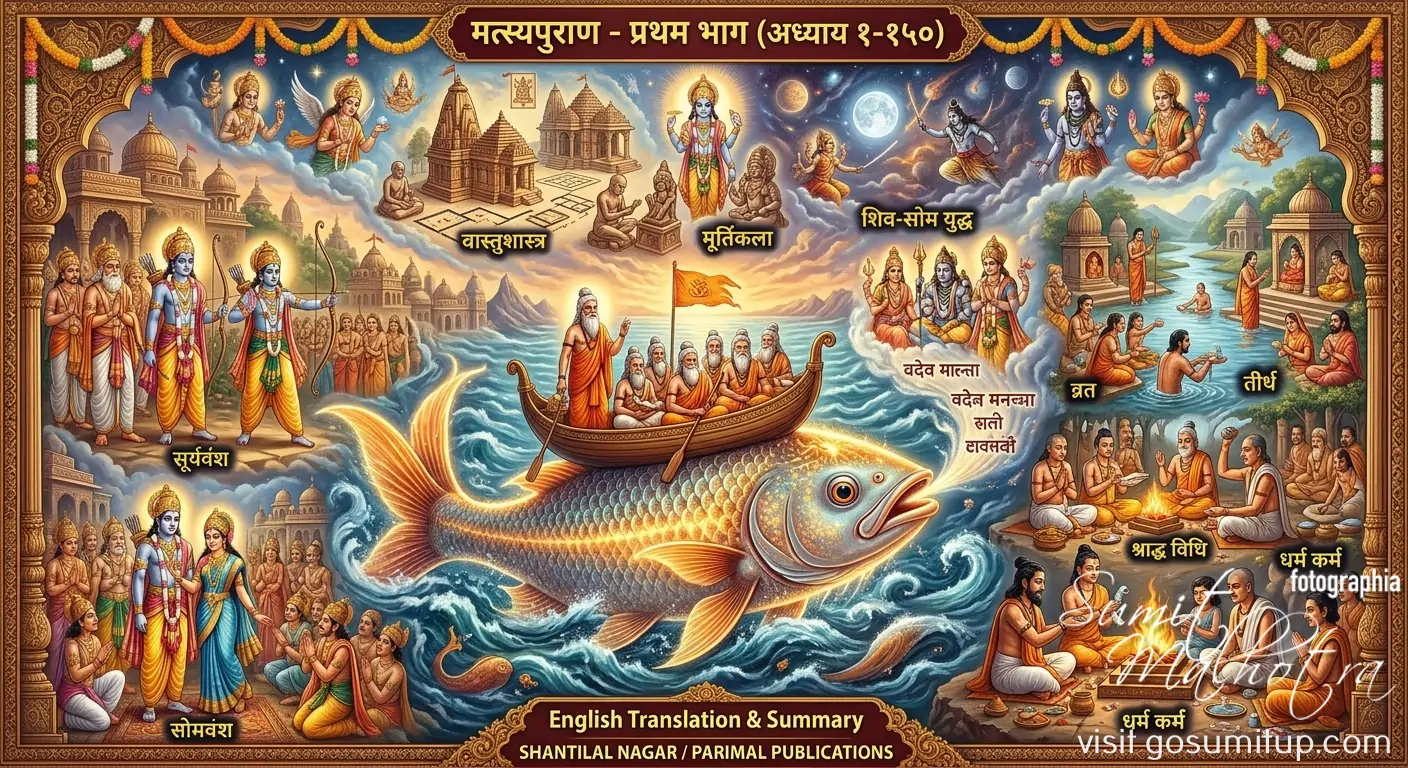
Introduction to the Matsya Purāṇa and the Fish Incarnation
The first 150 chapters of the Matsya Purāṇa culminate in a synthesis of cosmology, theology, and practical dharma.
Explore an in-depth synopsis of the Matsya Purāṇa (Vol. I, Chapters 1–150), featuring Lord Vishnu’s fish incarnation, cosmic creation, solar-lunar dynasties, and sacred rituals.
Learn more about: Matsya Purana, Hindu Mythology, Shantilal Nagar, Parimal Publications, Lord Vishnu Incarnations, Vedic Cosmology, Hindu Epics, Ancient Indian History, Sradha Rituals, Purana Synopsis, Hinduism, Puranas, Mythology, Lord Vishnu, Ancient India, Vedic Literature, Shantilal Nagar, Indian History, Matsya Purana Scripture Summary, Matsya Mahapurana, Mahapurana
The text opens in the sacred Naimiṣāraṇya forest, where sage Śaunaka and other ascetics inquire of Sūta about the mysteries of creation, the deeds of the gods, and particularly the motivation behind Lord Vishnu assuming the form of a fish (Matsyāvatāra).
Sūta narrates the account of Vaivasvata Manu, who retired to the Malaya mountains to perform intense asceticism (tapas).
Pleased by his devotion, Lord Brahmā grants him a boon: that Manu would possess the capacity to protect all mobile and immobile creatures during the final universal dissolution (pralaya).
While performing ancestral water oblations (tarpaṇa), Manu finds a tiny śapharī fish in his palm.
Moved by compassion, Manu places it in a water pot, where it rapidly grows. Moved successively to a jar, a well, a pond, the Ganges, and finally the ocean as its size expands to millions of yojanas, the fish reveals its true identity as Lord Janardana (Vishnu).
The Lord instructs Manu to build a massive vessel (identified with the Vedas) to house the seeds of all creation.
When the cosmic flood (ekārṇava) arrives, accompanied by scorching suns and submarine fires, Manu anchors the boat to the divine fish’s horn using the cosmic serpent as a rope, thus preserving life for the next cosmic cycle.
Following this, Chapter 3 details the primary creation (sarga), describing how Svayambhuva Narayana produced the primaeval waters, planted his seed, and brought forth the golden cosmic egg (Brahmāṇḍa) from which the creator Brahmā emerged.
A major portion of Matsya Purana Volume I is dedicated to genealogical records (vaṁśānucharita)
Cosmic Genealogies: Solar and Lunar Dynasties (Chapters 4–12, 23–24, 43–50)
Chapters 4–12, 23–24, 43–50 of the Matsya Purana chart the expansion of life through Daksha’s daughters, Kasyapa, and the solar line (Ikṣvāku vaṁśa).
- The Solar Line: Tracing descent through Ikṣvāku, Anaraṇya, Dilīpa, and Bhagīratha—who brought the sacred Ganges down from heaven—the lineage extends down to King Daśaratha and Śrī Rāma.
- The Lunar Line (Somavaṁśa): Chapter 23 details the miraculous birth of the Moon (Soma) from the eyes of sage Atri during his ascetic practices. Soma performs a grand Rājasūya sacrifice, wins the lordship of the stars, but later disrupts cosmic order by abducting Tārā, the wife of the divine preceptor Bṛhaspati. This triggers a cataclysmic war between the gods (led by Śiva) and the demonic/stellar allies of the Moon. Brahmā ultimately intervenes, forcing Soma to return Tārā. From Tārā’s womb, Budha is born, whose union with Ila produces King Purūravas—the protagonist of the famous Purūravas-Urvaśī narrative.
- The Yayati Chronicle: Chapters 28–43 recount the history of King Yayāti, his marriages to Devayānī (daughter of Śukrācārya) and Śarmiṣṭhā, and his curse of premature old age. When Yayāti asks his sons to exchange their youth for his old age, only the youngest, Pūru, complies, earning the kingdom and establishing the prestigious Pūru dynasty.
Chapters 13–22, 53–102 of Matsya Purana Outline Comprehensive Guidelines
Ancestral Rites, Vows, and Sacred Geography
The text outlines comprehensive guidelines for spiritual purification, ancestral worship, and religious observances (vratas).
- Pitr-vaṁśa and Śrāddha: Chapters 13 through 22 provide an exhaustive treatise on the manes (Pitrs), their classes (such as the formless Vārajus and corporeal Barhiṣads), and the procedural mechanics of Śrāddha. Sūta explains how food offerings made to Brāhmaṇas during a Śrāddha transform according to the departed soul’s karmic destination (whether reborn as a deity, animal, human, or insect). The famous story of the Kausika brothers illustrates how even an imperfectly performed Śrāddha retains spiritual potency, eventually guiding them to liberation after successive animal births.
- The 108 Names of the Goddess: Embedded within the ancestral narrative of Sati’s self-immolation at Daksha’s sacrifice and her rebirth as Menā’s daughter Pārvatī, the text lists 108 sacred names and corresponding shrines across India, serving as a vital early Śākta geographical directory.
- Vratas and Danas (Charity): Chapters 54 through 102 detail dozens of specialised vows (Nakṣatra-puruṣa, Bhīma Dvādaśī, Śiva-caturdaśī, etc.) and meritorious gifts (mahādānas), including symbolic mountains made of salt, raw sugar, gold, sesamum, cotton, and gems.
Chapters 129–150 of Matsya Purana Focus focus Heavily on Epic Cosmic Battles
Divine Conflicts: The Destruction of Tripura and Daitya Wars
The latter chapters of Volume I focus heavily on epic cosmic battles between the devas and the asuras.
- The Burning of Tripura: Chapters 129–140 recount the formidable threat posed by the demon Maya, who builds three flying citadels (Tripura) of gold, silver, and iron for the Daityas. Empowered by boons, the demons oppress the three worlds. At the request of the distressed gods, Lord Śiva constructs a divine chariot, utilising the earth as a chariot base, the sun and moon as wheels, and Mount Meru as a bow. With a single fiery arrow (Pāśupata), Śiva incinerates the flying cities, restoring cosmic equilibrium.
- The Tāraka Episode: Chapters 146–150 detail the birth of the invincible demon Tārakāsura following the penance of Vajrāṅga. Tāraka drives the gods into exile, setting the stage for the divine birth of Kārttikeya (Skanda) and subsequent full-scale warfare between the celestial hosts and the demonic armies.
Who wrote the Matsya Purana?
Who narrated the Matsya Purana?
- Original Sanskrit Text & Narrative: Maharṣi Veda-Vyāsa
- English Translation: A Board of Scholars (Edited by K.L. Joshi)
Who published the Matsya Purana?
Who are the publishers for Matsya Purana?
- Publisher: Parimal Publications, Delhi (2007 Edition)
What is notable in the Matsya Purana?
Key Stories and Teachings of Matsya Purana
- The Matsyāvatāra Legend: The narrative framework begins with King Manu’s encounter with a tiny fish on the banks of the Kṛtamālā River, which grows to cosmic proportions, warning Manu of the imminent universal deluge (pralaya) and guiding the rescue of the Vedas and living seeds.
- The 108 Names of the Goddess: A detailed devotional liturgy listing the sacred names and spatial manifestations of Goddess Satī/Pārvatī across major spiritual centres of India (e.g., Viśālākṣī at Vārāṇasī, Lalitā at Prayāga).
- The War Between Śiva and the Moon: The dramatic chronicle of the Moon (Soma) abducting Tārā (wife of Bṛhaspati), culminating in a celestial war between the gods and the planetary forces before Brahmā intervenes.
- Vāstuśāstra and Iconography: Early technical guidelines covering town planning, domestic architecture, water reservoir consecration, and the classification of stone icons.
Why should we read the Matsya Purana?
What knowledge resides in the Matsya Purana?
The Matsya Purāṇa is one of the most foundational and encyclopedic texts in the Hindu Purāṇic tradition.
Volume I (Chapters 1–150) bridges cosmic creation with practical human ethics, detailing the evolution of the universe, early cosmological myths, and the philosophy behind Lord Vishnu’s fish incarnation (Matsyāvatāra).
Readers will gain profound insights into:
- The Origin of Rituals: Comprehensive instructions on Śrāddha (ancestral rites), sacred vows (vratas), and pilgrimage sites (tīrthas).
- Historical Lineages: Detailed accounts of the solar (Sūryavaṁśa) and lunar (Somavaṁśa) dynasties, tracing the lineage from Svāyambhuva Manu to historical and legendary rulers like Rama and the Pandavas.
- Ancient Sciences: Early expositions on temple architecture, town planning, iconographical parameters (Pratimālakṣaṇa), and planetary movements.
The first 150 chapters of the Matsya Purāṇa culminate in a synthesis of cosmology, theology, and practical dharma.
By intertwining primordial myths—such as the Fish incarnation and the churning of the ocean—with granular codes of social conduct, ritual purification, and sacred geography, the text establishes itself as an indispensable pillar of Hindu sacred literature, ensuring spiritual elevation and temporal well-being for its readers.
Disclaimer
If you like this article, you can let us know in the comments below or on social media using #gosumitup and tag @gosumitup on Facebook.
I am always happy to read your feedback, whether you liked the dish or made it. :)
Better still, take a picture and post it on Instagram and tag it as #gosumitup
Connect directly – You can also connect with me on Instagram, Facebook, or Pinterest.
And, keep visiting us for more of such awesomeness. Do bookmark gosumitup.com into your web browser now or simply subscribe to our browser notifications.
If you are an ardent traveller, you may find below a list of items that will fortify your travel experience. I use many of these myself for all my trips or roadtrips. They are modestly priced and quite important to keep handy for your safety.
- Travel Adapter – https://amzn.to/3A04EJp
- Action Camera – https://amzn.to/4eCSMfF
- Camera Mounts & Accessories – https://amzn.to/4eG4je2
- Dashcam – https://amzn.to/3U2j4Qc
- Neck Rest – https://amzn.to/3Y6ZP98
- Tyre Inflator – https://amzn.to/3U8HpDP
- Storage – https://amzn.to/3XVQFMI
- Car Laptop Charger – https://amzn.to/3XXMVdA
- Vacuum Cleaner Cordless – https://amzn.to/3Yo1hWd
- Air Mattress – https://amzn.to/4015Bvu
- Jack Ratchet Wrench – https://amzn.to/3YkxddO
- Cleaning Cloth Microfibre – https://amzn.to/3NIOFmt
- Rechargeable Solar LED Torch – https://amzn.to/3Yj4h5Y
- Electronics Accessories Organiser – https://amzn.to/3A04XUz
- Pocket Travel Data Transfer Tool – https://amzn.to/3zMTxnc
- Smart Tracker for Keys – https://amzn.to/3BTuIq0
- Camping Cookware Kit – https://amzn.to/3BIy0N3
- Rechargeable Electric Gas Lighter for Stoves – https://amzn.to/4orBsin
- Sleeping Bag – https://amzn.to/3U7v2rP
GoSumItUp is a personal blog written and edited personally by me. All opinions expressed are my own which are honest and have not been influenced by any means.
My reviews are dependent on the visits at the time and revisits will be reviewed again as they may have a different experience or the same.
I am not a food critic nor do I consider myself as one, this platform allows me to write and review my own personal dining experiences, may they be good or bad, delicious or not, all are honest and truthful opinions.
Suppose you disagree or agree with me at any point or do not receive the same experiences as I have. In that case, I do not hold any responsibility as everyone will have their own experiences that they will encounter themselves.
I pay for all meals. However, if any meals or product has been sponsored or compensated or if I was an invited guest, it will be clearly disclosed at the end of each review.
All images on this blog are my own unless stated otherwise. If you wish to use any of my photography for any purposes, please do not use it without any written permission and give credit and/or link back to the website.
If you would like to send a product or any sponsors/endorsements, it may or may not be published and reviewed on the website.
If you wish to send any products or invitations for any media, press or collaborations etc., consider if it is something related to the content of the website and if you see fit, please visit the Contact page for contact details.
Thank You.
Thank you for visiting GoSumItUp! I hope you enjoy the reviews & recipes found at www.gosumitup.com.
This page consists of disclaimers regarding the recipe, its outcome, nutrition, and food handling safety decisions.
The recipes have been cooked and compiled by me for general information only and should not be used to diagnose or treat any medical condition/s.
This information is not intended to diagnose, treat, cure, or prevent any disease as well.
GoSumItUp.com has used all reasonable care in compiling the information but offers no warranty as to its accuracy or its use in any possible form.
Consult a doctor or other health care professional for diagnosis and treatment of any medical condition/s. For more details please refer to our disclosure policy.
The nutritional and health information provided in this article is for educational and informational purposes only and is not intended as medical advice, diagnosis, or treatment.
While herbs have a long history of traditional and clinical use, individual health needs vary.
Always consult with a qualified healthcare professional, registered dietitian, or physician before introducing therapeutic doses of fenugreek into your daily diet, especially if you are pregnant, nursing, taking blood-thinning medications, or managing chronic conditions like diabetes.
