What is Brahmanda Purana Part 3?
Read Brahmanda Purana Part 3 of 5 - Brahma Purana in English
Synopsis of Brahmanda Purana Part 3: This excerpt from the Brahmāṇḍa Purāṇa (Part III, Section III: Upodghātapāda) details the legends of Paraśurāma and King Sagara’s lineage, concluding with the events surrounding the descent of the Gaṅgā.
Read about Brahmanda Purana Part 3, Parasurama legend, King Sagara story, Sage Kapila, descent of Ganga, Samantapancaka, Motilal Banarsidass Purana, Parasurama, King Sagara, Sage Kapila, Bhagiratha, Amshuman, Jamadagni, Kurukshetra, Samantapancaka, Hindu Mythology, Puranic Stories, Vedic Scriptures, Parasurama story, King Sagara legend, Sage Kapila and Sagara sons, descent of Ganga story, Hindu mythology Purana summary, Samantapañcaka Kurukshetra, Asamanjasa banishment
- The Legend of Paraśurāma (Chapters 44–47): After defeating King Kārttavīryārjuna to avenge his father, Jamadagni, Paraśurāma undergoes a twelve-year penance on Mount Mahendra. During his absence, Kārttavīrya’s sons murder Jamadagni and decapitate him, causing his wife, Reṇukā, to die of grief. Driven by intense wrath, Paraśurāma vows to exterminate the Kṣatriya race. He wages a relentless campaign, clearing the Earth of Kṣatriyas twenty-one times and filling five lakes at Kurukṣetra (Samantapañcaka) with their blood as a libation to his ancestors. Advised by his ancestors (Pitṛs) to cease the slaughter, Paraśurāma performs a grand horse-sacrifice (Aśvamedha), bestows the conquered Earth upon Sage Kāśyapa, and retires to Mount Mahendra to resume penance.
- King Sagara and the Extermination of Enemies (Chapters 47–49): Following Paraśurāma’s retirement, the Tālajaṅgha and Haihaya clans re-emerge and drive King Bāhu of Ayodhyā into forest exile, where he dies. His pregnant queen gives birth to Sagara at the hermitage of Sage Aurva. Raised under Aurva’s guidance, Sagara grows into a formidable warrior. Armed with sacred missiles, he wages a campaign against his father’s enemies—defeating the Haihayas, Tālajaṅghas, Śakas, Yavanas, Kambojas, Pāradas, and Palhavas. At the behest of Sage Vasiṣṭha, Sagara spares the lives of his vanquished foes but strips them of their Vedic rites, forces distinct alternative hair and beard dress upon them, and degrades them into outcastes. Sagara returns in triumph to Ayodhyā, marries Keśinī of Vidarbha, and establishes a prosperous, righteous reign.
- The Quest for Sons and the Banishment of Asamañjasa (Chapters 50–51): Lacking an heir, Sagara and his two wives, Keśinī and Sumati, perform penance at Aurva’s hermitage. Aurva grants a boon: Keśinī chooses a single son to perpetuate the royal line, while Sumati chooses sixty thousand sons. Keśinī gives birth to Asamañjasa, who later becomes possessed by a malicious spirit (Piśāca) and begins terrorising the citizens by drowning children in the Sarayū River. Consequently, Sagara banishes Asamañjasa, whose righteous young son, Aṁśumān, remains at court. Meanwhile, Sumati gives birth to a gourd-like foetus, which Aurva instructs to be divided and preserved in sixty thousand ghee jars; in time, sixty thousand strong, ruthless sons emerge.
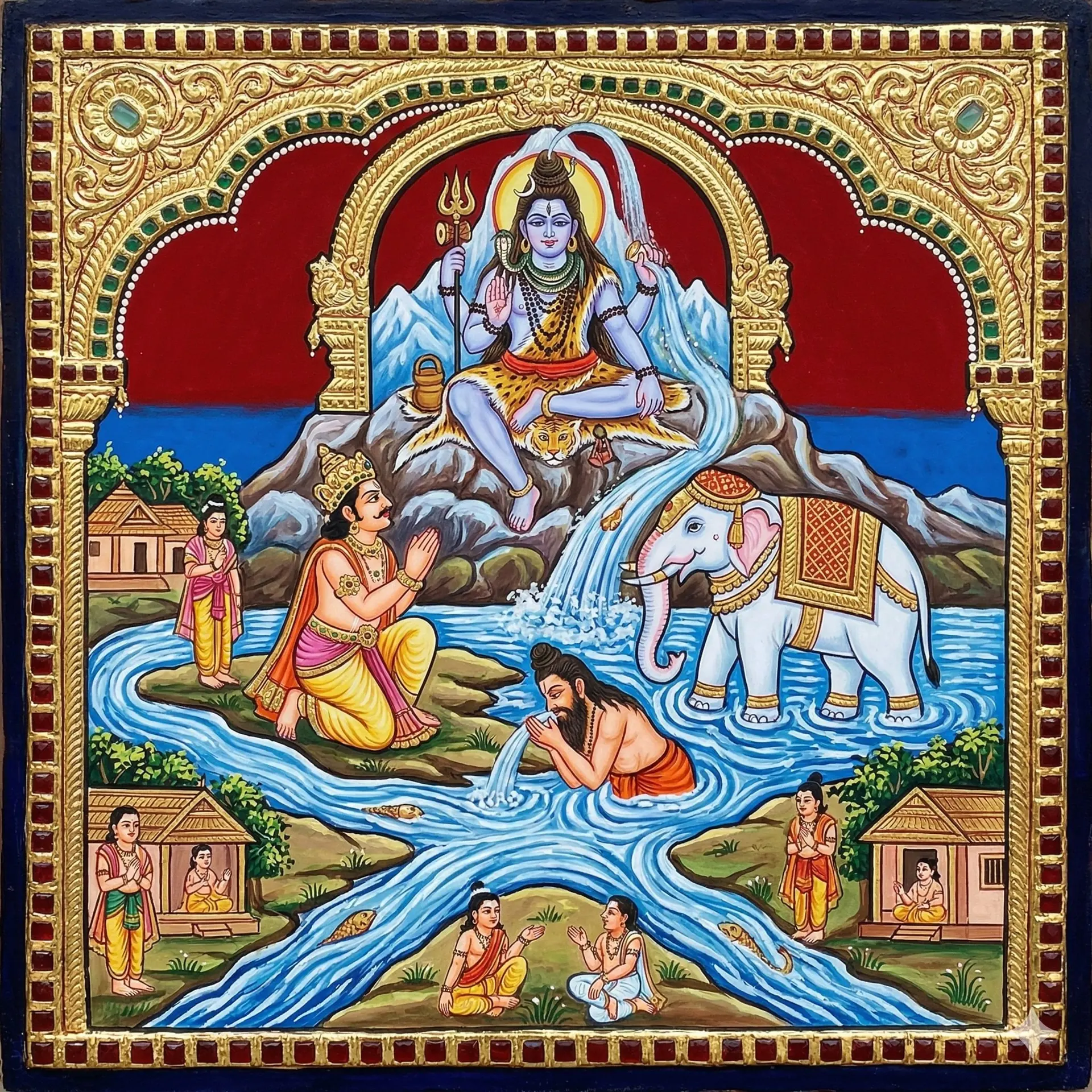
- The Loss of the Sacrificial Horse and the Fate of Sagara’s Sons (Chapters 52–54): To assert his sovereign authority, Sagara initiates a horse-sacrifice. Indicted by Indra, the sacrificial horse is stolen by the wind-god and brought to the netherworld (Pātāla) near the deep meditation spot of Sage Kapila. The sixty thousand sons dig into the Earth to search for it, causing widespread destruction. Finding the horse near Kapila, they foolishly accuse the meditating sage of theft and attack him. Kapila opens his eyes in fury, unleashing a consuming fire that instantly reduces all sixty thousand princes to ashes. Sage Nārada informs Sagara of the tragedy. Young Aṁśumān travels to Pātāla, appeases Kapila, and recovers the sacrificial horse. Kapila predicts that Aṁśumān’s future grandson, Bhagīratha, will eventually bring the holy river Gaṅgā down from heaven to purify their ashes and liberate their souls.
- Installation of Aṁśumān and the Sacred Geography (Chapters 55–56): Sagara completes his horse-sacrifice, bestows vast wealth upon the priests, and crowns Aṁśumān as the heir-apparent. The text elaborates on the geographical impact of the digging done by Sagara’s sons—which expanded the ocean (thereafter known as Sāgara)—and concludes with a description of the holy pilgrimage site of Gokarṇa on the western coast.
Who wrote the Brahmanda Purana?
Who narrated the Brahmanda Purana?
The narration of the Brahmanda Purana follows a layered frame-story structure:
1. Primary Frame Narrator: Lomaharshana (Suta)
The primary outer frame of the Brahmanda Purana is narrated by Lomaharshana (a disciple of Sage Veda Vyasa), belonging to the Suta class of traditional raconteurs. He recites the text to an assembly of sages gathered during a great sacrificial ritual (yajna).
2. Divine Source: Vayu (The Wind God)
Lomaharshana states that he learned the Purana from Sage Veda Vyasa, who originally received the divine discourse from Vayu (the Wind God).
Because of Vayu’s primary role as the original divine speaker, the Brahmanda Purana is closely linked with the Vayu Purana and historically served as an oral tradition relayed by Vayu during an ancient sacrifice at Naimisharanya.
Key Embedded Narrators
Because the Brahmanda Purana is structured as a series of inner dialogues, major sub-sections feature different primary narrators:
- Lalitopakhyana: Narrated as a dialogue between Lord Hayagriva (an incarnation of Vishnu) and Sage Agastya. Hayagriva recounts the history, glory, and worship of Goddess Lalita Tripura Sundari.
- Adhyatma Ramayana: Framed as a dialogue between Lord Shiva and Goddess Parvati, where Shiva reveals the spiritual nature of Lord Rama as the Supreme Being.
Who published the Brahmanda Purana?
Who are the publishers for Brahmanda Purana?
The English translation and critical edition of The Brahmanda Purana (Part 3)—which forms Volume 24 of the Ancient Indian Tradition and Mythology series—is published by Motilal Banarsidass Publishing House (MLBD).
Additionally, the original Sanskrit text editions are historically published by traditional Indian publishers such as the Venkateshwar Steam Press and Gita Press (Gorakhpur).
What is notable in the Brahmanda Purana Part 3?
The third part (Upodghātapāda) of the Brahmāṇḍa Purāṇa is notable for its extensive focus on the legends of Paraśurāma, the solar dynasty of King Sagara, and the lineage leading up to the Gaṅgā’s descent.
- The Legend and Wrath of Paraśurāma: It details Paraśurāma’s campaign to avenge his father Jamadagni by eradicating the Kṣatriya race twenty-one times, filling the five lakes of Samantapañcaka at Kurukṣetra with their blood, and eventually performing an Aśvamedha (horse sacrifice) to donate the conquered Earth to Sage Kāśyapa before retiring to Mount Mahendra.
- King Sagara’s Conquests and Social Reform: It recounts how Sagara, raised by Sage Aurva, defeated his father’s enemies (including the Haihayas, Śakas, Yavanas, and Kambojas) and, under Sage Vasiṣṭha’s advice, spared their lives but stripped them of Vedic rites, forcing unique appearances upon them and degrading them into outcastes.
- The Sixty Thousand Sons and Sage Kapila: It narrates the boon granted by Sage Aurva resulting in Sagara’s 60,000 sons, their tragic demise when Sage Kapila’s fiery glance reduced them to ashes for accusing him of stealing the sacrificial horse, and the prophecy that Bhagīratha would later bring down the Gaṅgā to liberate their souls.
- Exile of Asamañjasa: It covers the story of Sagara’s eldest son, Asamañjasa, who was possessed by a Piśāca and drowned local children in the Sarayū River, leading to his exile while his righteous son, Aṁśumān, was retained at court.
- Sacred Geography and the Creation of Sāgara: It explains the geographical impact of the massive excavations undertaken by Sagara’s sons across the Earth, which expanded the ocean (giving rise to the name Sāgara), and includes descriptions of sacred sites such as Gokarṇa.
Disclaimer
If you like this article, you can let us know in the comments below or on social media using #gosumitup and tag @gosumitup on Facebook.
I am always happy to read your feedback, whether you liked the dish or made it. :)
Better still, take a picture and post it on Instagram and tag it as #gosumitup
Connect directly – You can also connect with me on Instagram, Facebook, or Pinterest.
And, keep visiting us for more of such awesomeness. Do bookmark gosumitup.com into your web browser now or simply subscribe to our browser notifications.
If you are an ardent traveller, you may find below a list of items that will fortify your travel experience. I use many of these myself for all my trips or roadtrips. They are modestly priced and quite important to keep handy for your safety.
- Travel Adapter – https://amzn.to/3A04EJp
- Action Camera – https://amzn.to/4eCSMfF
- Camera Mounts & Accessories – https://amzn.to/4eG4je2
- Dashcam – https://amzn.to/3U2j4Qc
- Neck Rest – https://amzn.to/3Y6ZP98
- Tyre Inflator – https://amzn.to/3U8HpDP
- Storage – https://amzn.to/3XVQFMI
- Car Laptop Charger – https://amzn.to/3XXMVdA
- Vacuum Cleaner Cordless – https://amzn.to/3Yo1hWd
- Air Mattress – https://amzn.to/4015Bvu
- Jack Ratchet Wrench – https://amzn.to/3YkxddO
- Cleaning Cloth Microfibre – https://amzn.to/3NIOFmt
- Rechargeable Solar LED Torch – https://amzn.to/3Yj4h5Y
- Electronics Accessories Organiser – https://amzn.to/3A04XUz
- Pocket Travel Data Transfer Tool – https://amzn.to/3zMTxnc
- Smart Tracker for Keys – https://amzn.to/3BTuIq0
- Camping Cookware Kit – https://amzn.to/3BIy0N3
- Rechargeable Electric Gas Lighter for Stoves – https://amzn.to/4orBsin
- Sleeping Bag – https://amzn.to/3U7v2rP
GoSumItUp is a personal blog written and edited personally by me. All opinions expressed are my own which are honest and have not been influenced by any means.
My reviews are dependent on the visits at the time and revisits will be reviewed again as they may have a different experience or the same.
I am not a food critic nor do I consider myself as one, this platform allows me to write and review my own personal dining experiences, may they be good or bad, delicious or not, all are honest and truthful opinions.
Suppose you disagree or agree with me at any point or do not receive the same experiences as I have. In that case, I do not hold any responsibility as everyone will have their own experiences that they will encounter themselves.
I pay for all meals. However, if any meals or product has been sponsored or compensated or if I was an invited guest, it will be clearly disclosed at the end of each review.
All images on this blog are my own unless stated otherwise. If you wish to use any of my photography for any purposes, please do not use it without any written permission and give credit and/or link back to the website.
If you would like to send a product or any sponsors/endorsements, it may or may not be published and reviewed on the website.
If you wish to send any products or invitations for any media, press or collaborations etc., consider if it is something related to the content of the website and if you see fit, please visit the Contact page for contact details.
Thank You.
Thank you for visiting GoSumItUp! I hope you enjoy the reviews & recipes found at www.gosumitup.com.
This page consists of disclaimers regarding the recipe, its outcome, nutrition, and food handling safety decisions.
The recipes have been cooked and compiled by me for general information only and should not be used to diagnose or treat any medical condition/s.
This information is not intended to diagnose, treat, cure, or prevent any disease as well.
GoSumItUp.com has used all reasonable care in compiling the information but offers no warranty as to its accuracy or its use in any possible form.
Consult a doctor or other health care professional for diagnosis and treatment of any medical condition/s. For more details please refer to our disclosure policy.
The nutritional and health information provided in this article is for educational and informational purposes only and is not intended as medical advice, diagnosis, or treatment.
While herbs have a long history of traditional and clinical use, individual health needs vary.
Always consult with a qualified healthcare professional, registered dietitian, or physician before introducing therapeutic doses of fenugreek into your daily diet, especially if you are pregnant, nursing, taking blood-thinning medications, or managing chronic conditions like diabetes.
